

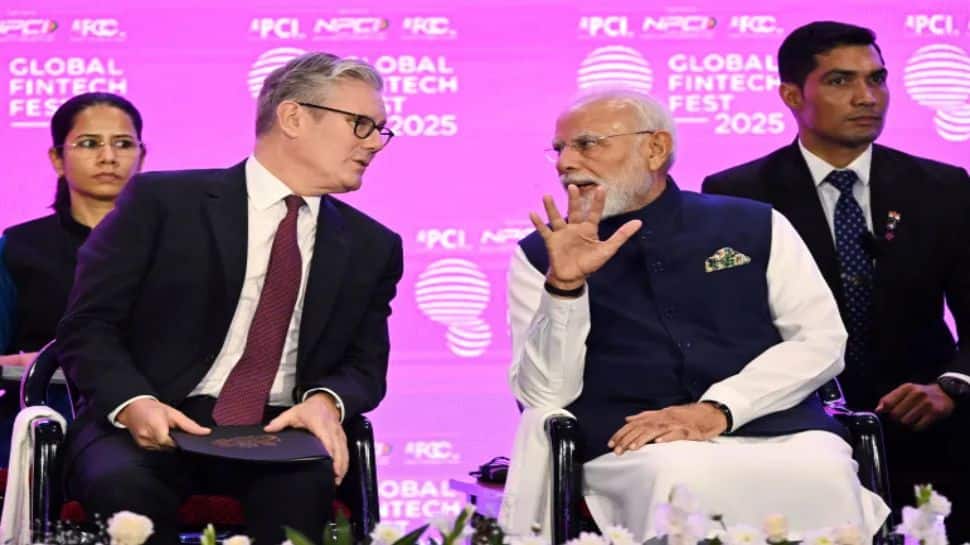
New Delhi: UK Prime Minister Keir Starmer visited India for the first time since taking office last year. He met Prime Minister Narendra Modi in Mumbai, India’s financial hub, accompanied by a delegation of British business and cultural leaders.
The main focus of the visit was India’s massive digital ID system, Aadhaar, which has issued more than 1.3 billion IDs. Starmer’s visit came two weeks after he announced plans for the UK’s own digital ID system, the Brit Card. He described Aadhaar as a “massive success” while defending the UK initiative, which has faced criticism from rights groups.
During his visit, he also met Nandan Nilekani, co-founder of Infosys and former head of the Aadhaar project, and sought insights into how India built and maintained the system and what lessons could apply to the United Kingdom.
Why UK Wants A Digital ‘Brit Card’
Starmer’s Brit Card is aimed at combating illegal work and irregular migration in the United Kingdom. The system will provide citizens a way to quickly verify their identity for accessing government services.
“A digital ID system will make it tougher to work illegally in this country, making our borders more secure,” Starmer said last month.
He added that the card would offer “countless benefits, like being able to prove your identity to access key services swiftly”.
Despite its proposed advantages, the idea has faced strong opposition. More than 2.2 million people signed a petition against the card. The petition described the Brit Card as a “step towards mass surveillance and digital control” and warned that “no one should be forced to register with a state-controlled ID system”.
Starmer highlighted the convenience the system could bring. “I do think that we could gain a significant advantage,” he said and explained that managing multiple documents for everyday tasks often leads to frustration.
How India’s Aadhaar Works
Aadhaar is larger and more detailed than the planned Brit Card. It collects fingerprints, eye scans, photos, home addresses and phone numbers, processing roughly 80 million authentications daily.
Each Indian citizen receives a 12-digit ID, which is used for opening bank accounts, getting SIM cards and accessing government benefits. Launched in 2009, Aadhaar has issued over 1.3 billion IDs and claims to have saved nearly $10 billion in administration costs. Critics argue that this figure may be exaggerated.
UK officials clarified that the Brit Card will not store biometric data. Instead, it will focus on basic identity verification and inclusivity.
Concerns Around Aadhaar
Aadhaar has experienced several large-scale data leaks. At times, the leaks exposed personal information for up to 85 percent of the population.
In January 2025, India allowed private companies access to the database for authentication. Critics warned that this access could lead to misuse of personal and biometric data.
“The core problem with Aadhaar was conceptual – centralisation of digital ID and accompanying biometric information that should have be avoided,” said Vrinda Bhandari, Supreme Court lawyer and digital rights expert.
She added that linking Aadhaar to other databases increases risk.
Public confidence in Aadhaar remains low. A survey earlier this year showed 87 percent of citizens believe their personal data is already exposed or compromised, up from 72 percent in 2022.
Critics also argued that Aadhaar sometimes complicates welfare delivery for marginalised citizens. Technical issues with fingerprints or internet connectivity have occasionally delayed pension or benefit payments. The Supreme Court approved Aadhaar for welfare and taxes but restricted its use in education and by private companies.
Global Influence Of Aadhaar
Several countries have looked to Aadhaar as a model. Kenya launched the Huduma Namba project in 2019, drawing heavily from Aadhaar, but faced legal challenges over privacy and inclusion.
Other nations, including the Philippines, Morocco and Ethiopia, also studied Aadhaar’s approach.
In the United Kingdom, rights groups raised privacy concerns about the Brit Card. Silkie Carlo, director of Big Brother Watch, warned that the system “will make Britain less free” and could expand into mass surveillance across citizenship, benefits and health systems.
Culture Secretary Lisa Nandy responded that ministers had “no intention of pursuing a dystopian mess”.
Trade And Investment Talks
Modi and Starmer also discussed boosting bilateral trade. More than 100 UK business and university leaders accompanied the British prime minister, following the July free-trade agreement aimed at doubling trade to $120 billion by 2030.
Addressing the UK delegation, Modi said, “India’s dynamism and the UK’s expertise together create a unique synergy.”
Starmer projected that new investments would create thousands of high-skilled jobs.
The two nations announced new initiatives, including an India-UK connectivity and innovation centre, a joint AI development centre and a critical minerals guild. Sixty-four Indian companies pledged 1.3 billion pounds ($1.73 billion) in UK investment.
Challenges In The Partnership
London and New Delhi do not agree on all issues. The United Kingdom has condemned Russia’s invasion of Ukraine, while India maintains strategic autonomy and continues to buy Russian oil. Starmer and Modi also have differences regarding Khalistan activism in the United Kingdom and previous media portrayals of India.
Despite these differences, both sides emphasised collaboration in trade, technology and innovation. Starmer’s visit signalled a new phase in UK-India relations.