

New Delhi/Washington: The Donald Trump administration in the United States has placed India at the centre of criticism over its oil imports from Russia. Senior U.S. officials, including Treasury Secretary Scott Bessent, claim that Indian purchases help fund the war in Ukraine. The administration has imposed a 25% tariff on Indian exports. A second 25% penalty came into force on August 27, raising total duties to 50%.
The United States alleges that India’s oil trade with Russia contributes directly to the war with Ukraine. According to U.S. Trade Adviser Peter Navarro, India is now central to ending the bloodshed. He has stated publicly that the road to peace runs through New Delhi.
India has repeatedly stated that it has no role in the Ukraine conflict. The country has not supplied weapons to either side. The Indian government supports diplomatic dialogue. It has offered to help mediate if asked. Indian officials have said the war is not theirs.
On the contrary, western nations have provided military aid to Ukraine. Large volumes of weapons and financial assistance have come from the United States and Europe. Their stated goal is to impose a strategic defeat on Russia. Since that goal has not been achieved even after two years of the intense exchange of fire power, India has been accused of undermining western efforts, despite not participating in the conflict.
Accusations of Profiteering
Navarro has claimed that Indian companies are importing oil far beyond domestic needs. He says they refine cheap Russian oil and re-export the products. He accuses them of profiteering. India has not denied refining oil for export. The country has clarified its position.
External Affairs Minister S. Jaishankar says India buys oil in line with global pricing rules. He says the United States previously advised India to purchase discounted Russian oil. He points out that Europe has been one of the largest buyers of India’s refined fuels. The trade is legal. It follows market demand. No refined product was forced onto any buyer.
U.S. and European firms also participate in this trade. No action has been taken against them. The United States itself sells liquefied natural gas (LNG) to Europe. A recent deal requires Europe to buy $750 billion worth of American LNG over three years. U.S. oil firms benefit. American defence companies also gain from arms sales to Ukraine. These points have not drawn criticism from Bessent and Navarro.
Weapon Sales And Infrastructure
The United States has supplied arms to Europe worth $90 billion. These are for onward transfer to Ukraine. America has also approved the sale of 3,350 extended range attack munitions (ERAMs). These weapons are intended for use in the Ukraine war. Indian oil imports have received greater attention from U.S. officials than these arms shipments.
According to Jaishankar, the United States applies its standards unevenly. The sale of discounted oil is legal. Business decisions made by Indian companies are legal. The Russian oil they buy is within the price cap set by the G7. There is no legal violation.
Jaishankar highlights that India imports oil to serve national interest. It reduces energy costs. It boosts the economy. He calls accusations of running a “laundromat” for Russia hypocritical.
Trade Penalties, Economic Impact
India imports about 85% of its oil needs. Russia supplies between 18% to 20%. Imports from Iraq make up about 20% to 23%. Saudi Arabia supplies 16% to 18%. The UAE contributes 8% to 10%. The United States provides 6% to 7%. Nigeria and West African nations supply 5% to 6%.
In 2024-25, Russia’s share rose to 36% by volume. The Middle East accounted for 46%. CIS countries (Russia, Kazakhstan, Azerbaijan) made up 39% of total imports by value. India sourced oil from about 40 countries.
From January to July 2025, India imported 1.73 million barrels per day (bpd) from Russia. That equalled over one-third of its total oil needs.
In comparison, imports from the United States reached 271,000 bpd. Brazilian imports stood at 73,000 bpd. Nigerian and Kuwaiti volumes remained modest.
Indian refiners, led by Reliance Industries and Nayara Energy, handled 60% of Russian imports. The crude was refined and exported in many cases. Europe has been a major buyer of those products.
The Trump administration announced steep tariffs on Indian goods. The new rate affects 55% of India’s $87 billion in exports to the United States. Products hit include apparel, shrimp, processed diamonds and furniture. Pharmaceuticals and electronics were not targeted.
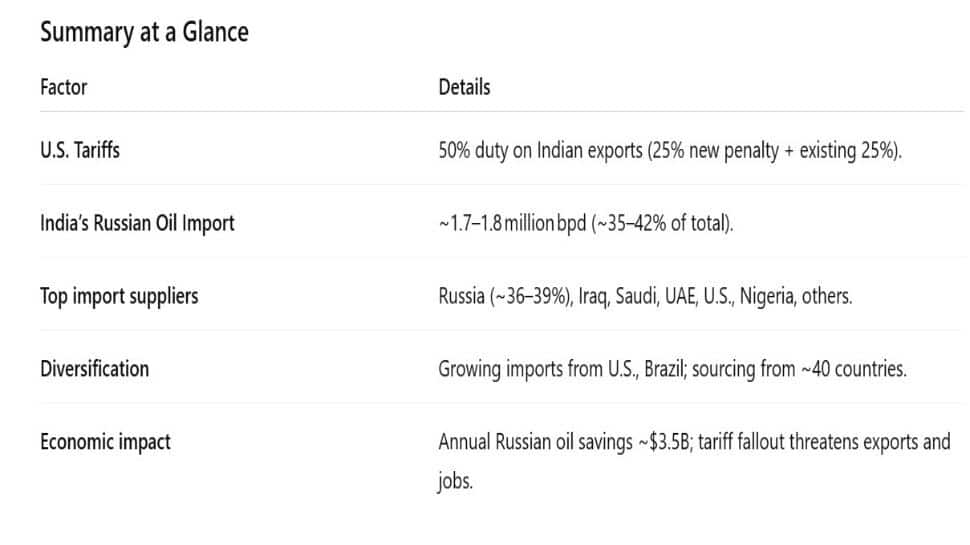
Industry groups warn of job losses. Order books for Indian exporters have started to shrink. The Indian government plans to support affected industries. Officials also intend to explore alternative export markets.
China’s Oil Purchases From Russia
China remains the largest buyer of Russian oil and gas. In 2024, Chinese imports reached 108 million metric tons. These supplies arrive through pipelines under long-term contracts. They are not affected by the G7 price cap.
Despite that, China has not faced penalties from the Trump administration. China continues to buy from Russia without consequences. The United States and Europe have only requested that Beijing stop sending military aid to Moscow.
Navarro says India increased Russian oil imports from 1% to 30%-35%. He says that China maintained steady volumes at around 20%. He also claims China has more diverse sources. Indian officials reject this argument.
India has diverse sources of oil. It imports large volumes from the Middle East, Africa, North America and Latin America. Data shows that Russia supplies 20% of India’s oil needs. China, in contrast, imports large quantities from Iran, which is under U.S. sanctions. No action has been taken against those imports.
China’s energy trade continues without U.S. trade penalties. India faces higher tariffs despite smaller import volumes and greater compliance. Critics call the approach unfair. Indian officials say the trade relationship with the United States must be based on equity and respect. The country has chosen not to yield to pressure.
(Data sourced from Reuters, The Wall Street Journal, Financial Times, Politico, The Times of India, The Economic Times, Business Standard, U.S. Energy Information Administration, ETEnergyworld.com, OilPrice.com, ETAuto.com)