

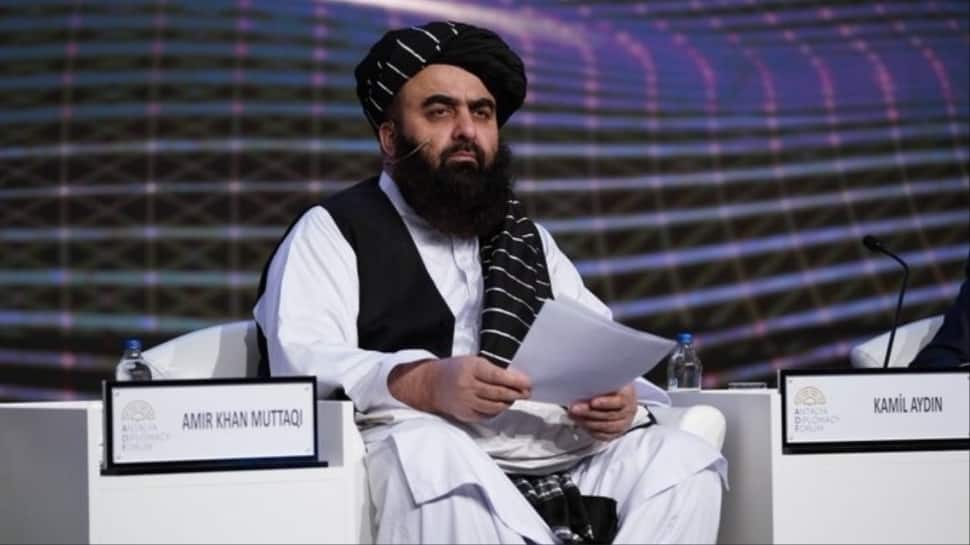
In a significant move poised to alter regional geopolitics, Afghan Foreign Minister Amir Khan Muttaqi of the Taliban government is scheduled to visit India on 9 October. This marks the first high-level delegation from Kabul to New Delhi since the Taliban took control of Afghanistan in August 2021, signalling a new phase in India-Taliban relations, as per reports.
According to an NDTV report, the United Nations Security Council has authorised a temporary exemption from international travel restrictions for Muttaqi, permitting his visit to New Delhi between 9 and 16 October. This exemption highlights the importance both the Taliban administration and regional actors place on this visit as they seek to recalibrate diplomatic ties.
Indian officials have been preparing for this visit for several months. Since January, senior diplomats, including Foreign Secretary Vikram Misri and IFS officer J.P. Singh, have engaged in multiple rounds of talks with Muttaqi and other Taliban representatives, often meeting in neutral locations such as Dubai, as per reports. Notably, Foreign Secretary Misri met Muttaqi in Dubai, where discussions focused on India’s ongoing humanitarian assistance to Afghanistan, particularly efforts to strengthen the health sector and support refugee rehabilitation.
A key development occurred on 15 May, following India’s successful Operation Sindoor against Pakistan, when External Affairs Minister S. Jaishankar spoke by phone with Muttaqi, the first ministerial-level contact since 2021. During this conversation, Jaishankar commended the Taliban for condemning the Pahalgam terror attack and reaffirmed India’s “traditional friendship with the Afghan people.”
In April, the Taliban condemned the Pahalgam terror attack in Indian-administered Kashmir during a high-level meeting in Kabul with Indian officials, where detailed information about the attack was shared. This statement signalled a convergence of views between India and Afghanistan regarding Pakistan-sponsored terrorism in the region, as per reports.
India has since expanded direct humanitarian aid to Afghanistan, supplying food grains, medical supplies, and development assistance. Sources reveal that the Taliban administration has formally communicated various needs to India, including support for energy and infrastructure projects.
Following the devastating earthquake in September, India was among the first countries to respond, dispatching 1,000 family tents and 15 tonnes of food to the hardest-hit provinces. This was quickly followed by an additional 21 tonnes of relief materials, including essential medicines, hygiene kits, blankets, and generators, underscoring India’s commitment to assisting the Afghan population in times of crisis.
Since the Taliban’s takeover in August 2021, India has provided nearly 50,000 tonnes of wheat, over 330 tonnes of medicines and vaccines, and 40,000 litres of pesticides, alongside other essential supplies. These sustained efforts have been vital for millions of Afghans facing food shortages, health crises, and humanitarian distress.
The visit is widely viewed as a setback for Pakistan, which has traditionally sought to maintain influence over Kabul. Islamabad’s recent decision to repatriate over 80,000 Afghan refugees earlier this year strained relations with the Taliban, creating diplomatic space for India to assert a stronger role. Analysts suggest Muttaqi’s trip to New Delhi signals Kabul’s intent to diversify its foreign relations and lessen reliance on Pakistan.
For India, the visit is a calculated yet sensitive move. Direct engagement with the Taliban government aims to protect India’s long-term strategic interests in Afghanistan, prevent terror threats emanating from the region, and counterbalance the influence of China and Pakistan.
The bilateral meeting scheduled for 10 October during Muttaqi’s visit could prove a watershed moment, potentially setting India and Afghanistan on a new path of cautious cooperation that may reshape power dynamics across South Asia.