

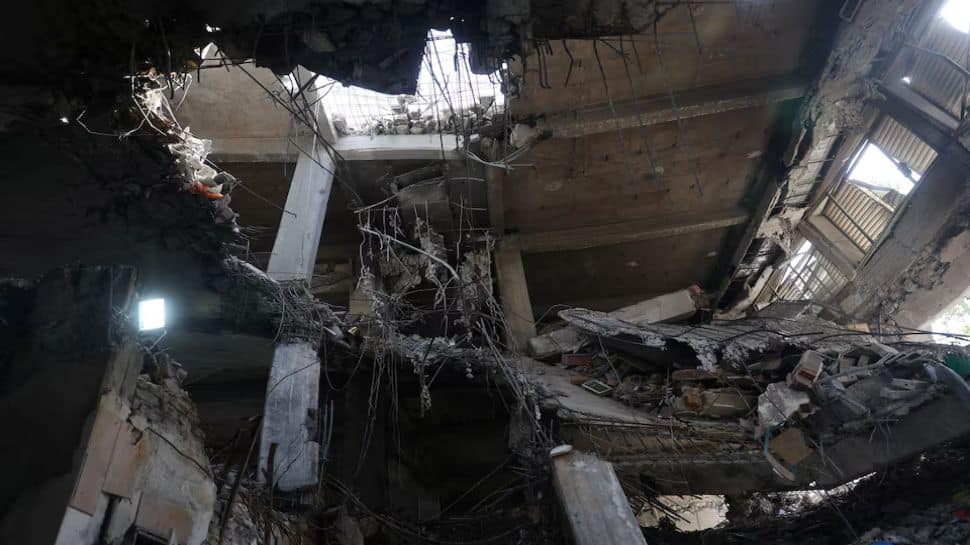
Tehran: On the night of June 23, sirens failed to warn. The earth shook beneath Evin Prison in Iran’s capital. Minutes later, smoke blanketed the high-security compound. When the air cleared, dozens were dead and many more were trapped inside.
Among them was Motahareh Gunei, a political prisoner. “When the bombs hit, it was not the worst moment. Hell began when they did not open our cell doors,” she recalled the moment with BBC.
She had been held in solitary confinement, locked away in one of Iran’s most heavily guarded facilities, one that has held political detainees for over 50 years.
That night, Israel launched strikes on several Iranian targets. The attack on Evin, according to BBC, was among the deadliest.
Iranian authorities confirmed 80 fatalities, including prison guards, medical staff, visitors and nearby residents. The government claimed the prison had been used for intelligence operations against Israel.
The Israel Defense Forces (IDF) later stated, “Evin was a hub for operations targeting Israeli security. This was a precision strike.”
But images from the ground told a different story story – burned corridors, collapsed roofs and terrified prisoners scrambling through smoke-filled hallways.
“When I heard the third explosion, I knew we were not getting out. I banged on the door with everything I had. It did not move. That was when I thought it was the end. I thought I would die in that room,” she told the outlet’s Persian service.
Eventually, another prisoner opened her door. She stumbled out, disoriented and coughing through thick smoke. Outside her cell, she found chaos and silence.
In the hours that followed, prisoners helped the wounded. Some tended to injured guards. Others carried elderly inmates down staircases. There was no emergency response.
Citing an inmate, BBC reported that the prison officials did not initially let inmates out. Even when the windows shattered and the walls shook, the guards shouted that that all inmates had to stay in their cells.
Dr. Saeideh Makarem, a prison doctor, was seriously injured during the blasts. Days later, she wrote on Instagram, “It was the inmates I once treated who saved my life.”
Inmates broke open clinic doors in another section of the prison to rescue trapped medical staff. The smoke was dense. Visibility was near zero. Some collapsed trying to escape.
BBC claims that at least six missiles struck the prison. Twenty-eight structures were damaged across the compound.
The IDF said the operation was carried out to minimise civilian harm. But what happened outside the prison suggested otherwise.
One man, whose relative was incarcerated, arrived minutes after the strike. “People were pouring out, some covered in blood. They were in shock. No one was running. There was silence and bodies,” he said.
Among the dead were:
Masoud Behbahani, a dual U.S.-Iranian citizen held on financial charges. His family says they received no clear explanation from Iranian officials about how he died.
Arvin Mohammadi, 37, who was at the prison to post bail for his father.
Mehrangiz Imanpour, 61, a renowned artist who was killed by shrapnel near the visitor’s area.
A social worker, a woman with her one-year-old child, five activists, 13 young conscripts and a five-year-old were also among the dead. Officials released only the names of prison staff.
Iran reported that 75 inmates escaped during the chaos. Several were later recaptured or returned voluntarily. Five prisoners were confirmed dead. Their identities remain undisclosed.
Over 100 transgender inmates are still missing. Reza Shafakhah, a lawyer monitoring their cases, told BBC, “We don’t know where they are. Their whereabouts remain unknown.”
The United Nations said the facility was not a legitimate military target. Amnesty International called the strike indiscriminate. In a statement, Erika Guevara-Rosas, Amnesty’s Senior Director for Research and Policy, said, “Targeting civilian infrastructure violates international law. Doing so deliberately amounts to a war crime.”
Motahareh Gunei remembers everything: the darkness, the heat, the screams and the smell of dust and fire. And also the moment she thought her life had ended in a locked cell that no one came to open.