

Beijing: The Chinese military has carried out a lethal experiment in a laboratory. Scientists of the People’s Liberation Army (PLA) performed a “triple-nuclear strike” test for the first time. This test uses several small warheads that can be fired in quick succession or almost simultaneously. The method significantly multiplies the destructive effect.
Until now, research around the world focussed only on single warheads. Even existing weapons relied on single-warhead designs. China has now moved far ahead in this field, making its weapons considerably more lethal. The test shows that if three small nuclear warheads detonate almost simultaneously, the resulting destruction is immense. Although the official goal is to destroy bunkers, the experiment demonstrates a capability that could alarm other nations.
The research was conducted by the Nanjing Army Engineering University and was published in the journal Explosion and Shock Waves. According to the report, Chinese scientists aimed to study the effect of detonating three small nuclear attacks at nearly the same location at the same time.
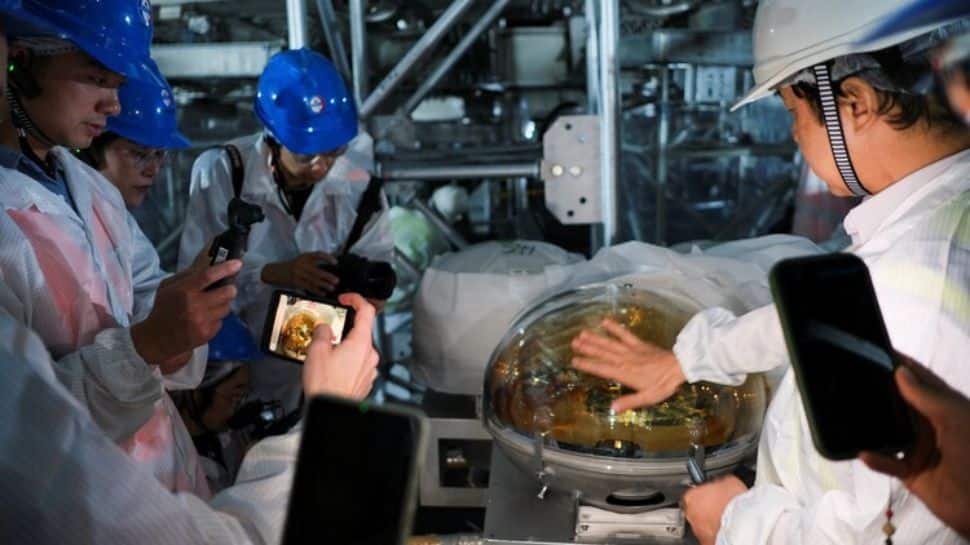
The team modelled and tested the triple-hit effect using a small-scale controlled experiment. They employed a vacuum chamber and a two-stage high-pressure gas gun. Small projectiles broke glass pressure spheres, releasing energy similar to a nuclear blast. The test closely simulated the effects of a real nuclear detonation in terms of shock and explosive force.
The experiment achieved destruction in milliseconds. The interval between one warhead’s explosion and the next was only 0.8 milliseconds. In other words, all three blasts occurred in less than one millisecond. This near-simultaneous detonation amplified the impact. The team compared the results with older tests, such as the 1965 Palanquin experiment.
They found that the new explosions created craters more than twice as deep and wide. Surface damage increased many times over. In simple terms, three closely timed explosions generate shock waves in soil and rock that combine to produce far more destruction than separate blasts would cause.
The experiment is particularly important because modern militaries store critical nuclear and underground assets in hardened bunkers. Conventional bombs or missiles often fail to destroy these structures. Past conflicts have demonstrated this limitation, as seen in Israel’s unsuccessful attempts to destroy fortified bunkers in Iran.
If China converts this experiment into an operational weapon, it could obliterate entire bunkers almost instantly. The small size of individual warheads allows targeting only specific locations. These weapons could be deployed using hypersonic or other advanced missile systems. Low-time synchronisation and rapid communication further increase their lethality. The test also raises concerns about radioactive fallout, which could have serious consequences.
It can shift strategic balance in South Asia. For India, implications are clear; and therefore, it must strengthen the security of deep bunkers, nuclear facilities and sensitive sites. Missile defence systems and research and development efforts must be upgraded. Rapid detection and immediate response capabilities require significant investment.
The Chinese laboratory report acts as a warning. New technologies not only change weapons but also alter how they may be used. Countries must prepare scientifically, strategically and politically for these developments.
The Nanjing report reveals a new level of destructive capability. The experiment demonstrates faster and more concentrated damage. It raises urgent questions about deterrence and vulnerability.