

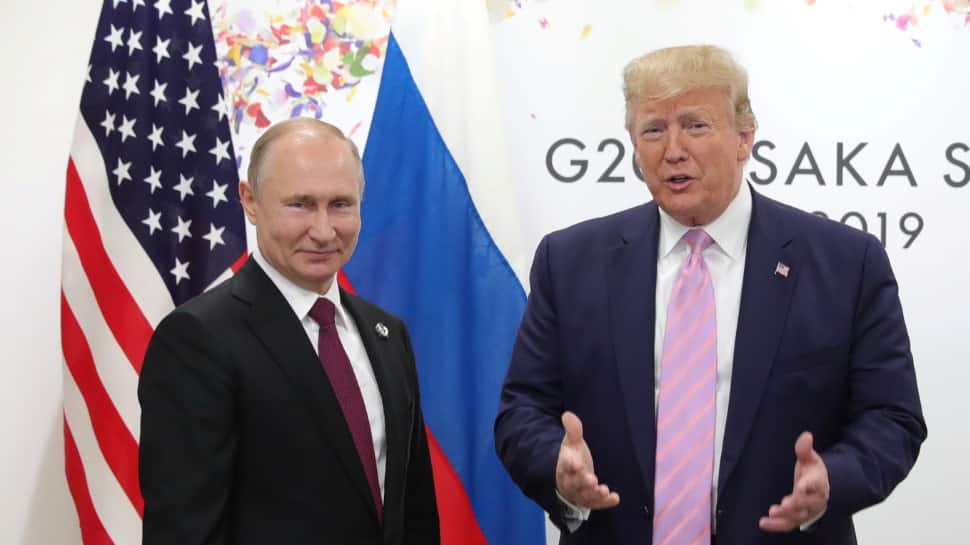
New Delhi: US President Donald Trump warned on Wednesday that there would be “very severe consequences” if Russian President Vladimir Putin does not agree to end the war in Ukraine during their upcoming summit on Friday.
As per the media reports, according to French President Emmanuel Macron, Trump was “very clear” during a virtual meeting with European leaders that the US is aiming for a ceasefire at the forthcoming US-Russia summit, set to take place in Alaska.
During the same meeting, Ukrainian President Volodymyr Zelensky told the group that he believes Putin “is bluffing” ahead of his planned talks with Trump.
“Putin is trying to apply pressure … on all sectors of the Ukrainian front,” Zelensky said, to demonstrate that Russia is “capable of occupying all of Ukraine.”
He also accused Putin of feigning indifference to sanctions. “He is bluffing about sanctions, as if they do not matter to him and are ineffective. In reality, sanctions are very helpful and are hitting Russia’s war economy hard,” Zelensky stated.
According to an Associated Press report, speaking after the video conference between Trump, Zelensky, and European leaders, Macron noted that Trump is prioritising a ceasefire between Ukraine and Russia. He also said Trump had made it clear that “territorial issues relating to Ukraine … will only be negotiated by the Ukrainian president.”
Following Friday’s meeting with Putin, Trump also intends to “seek a future trilateral meeting” involving himself, Putin, and Zelensky, Macron revealed.
“I think that’s a very important point in this regard. And we hope that it can be held in Europe, in a neutral country that is acceptable to all parties,” he said.
German Chancellor Friedrich Merz convened the virtual meetings to ensure European and Ukrainian leaders’ voices are heard before the Trump-Putin summit, where the two are expected to discuss a potential roadmap toward ending Russia’s war in Ukraine.
Speaking alongside Zelensky, who travelled to Berlin on Wednesday to participate, Merz described the meeting with Trump as “constructive” and emphasised that “important decisions” could be made in Anchorage. However, he underlined that “fundamental European and Ukrainian security interests must be protected” during the summit, the report added.
Zelensky and European leaders have been excluded from the Alaska summit. German government spokesperson Steffen Meyer said Wednesday’s meetings aimed to “make clear the position of the Europeans.”
A separate call was expected later on Wednesday between leaders of countries in the so-called “coalition of the willing”, those ready to help enforce any future peace agreement between Moscow and Kyiv.
Before arriving in Berlin, Zelensky said his government had held over 30 conversations with international partners in preparation for the summit, but reiterated his scepticism about Putin’s intentions.
On his official Telegram channel, Zelensky wrote that there is “currently no sign that the Russians are preparing to end the war,” urging Ukraine’s partners in the US and Europe to coordinate more closely and “force Russia to peace.”
“Pressure must be applied on Russia for an honest peace. We must take the experience of Ukraine and our partners to prevent deception by Russia,” he added.
Trump has said he wants to determine whether Putin is serious about ending the war, now in its fourth year, and described Friday’s summit as “a feel-out meeting” to assess the Russian leader’s intentions.
However, Trump has unsettled European allies by suggesting that Ukraine may need to cede some Russian-held territory. He has also floated the idea of land swaps, though it remains unclear what Russia might be expected to give up in return.
European leaders insist Ukraine must be directly involved in any peace negotiations, fearing that a bilateral agreement between the US and Russia could tilt in Moscow’s favour.
On Monday, Trump declined several opportunities to confirm whether he would push for Zelensky’s inclusion in discussions with Putin, and appeared dismissive of the Ukrainian leader’s role. Trump said a meeting between Putin and Zelensky might follow Friday’s summit or that it could involve “Putin and Zelensky, and me.”
Ukraine and its European allies remain concerned that Putin, who launched the largest land war in Europe since 1945 and has used Russia’s energy dominance to pressure the EU, might gain favourable concessions if Kyiv is not at the negotiating table.
A key fear among many European nations is that if Putin is successful in Ukraine, he may then target one of them.
On Tuesday, Zelensky said Putin is demanding that Ukraine withdraw from the remaining 30% of the Donetsk region that it still controls as part of a proposed ceasefire. Zelensky categorically rejected the idea.
He reiterated that Ukraine would not cede any territory it currently holds, calling such a move unconstitutional and warning it would merely provide a springboard for further Russian aggression.
Zelensky also criticised US-led diplomatic efforts for failing to meet Ukraine’s core demands, including security guarantees to deter future Russian attacks and the inclusion of Europe in the talks.
Three weeks into his return to office, Trump’s administration removed Ukraine’s potential NATO membership from the agenda, a key Russian demand, and signalled that the EU and Ukraine should now handle European security, while the US shifts focus elsewhere.
Senior EU officials believe Trump may be primarily interested in securing a ceasefire rather than a comprehensive peace deal, with broader US geopolitical interests, including improved trade with Russia and rehabilitating Putin, taking precedence.
Meanwhile, Russian forces continue to press in on a strategic objective: the city of Pokrovsk, located in the eastern Donbas region, which forms the industrial heart of Ukraine and has long been a target for the Kremlin.
Military analysts monitoring the conflict say Ukraine’s ability to hold Pokrovsk could prove critical. Losing the city would give Russia a significant victory ahead of the summit and could jeopardise Ukrainian supply lines in Donetsk, where most of Russia’s military efforts are currently focused.