

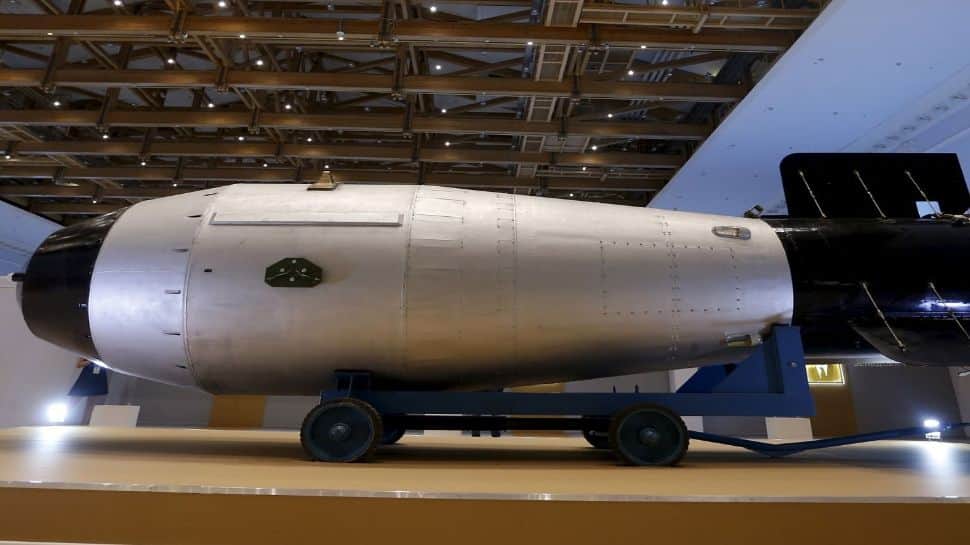
Washington/New Delhi/Beijing: The United States has announced plans to resume nuclear testing for the first time in 33 years. The announcement was made ahead of a planned meeting between Donald Trump and Chinese Premier Xi Jinping. The U.S. president said the move is aimed at countering the rapid build-up of weapons by Russia and China. He also claimed Washington holds the world’s largest arsenal, with Moscow second and Beijing a distant third.
U.S. officials described the decision as a timed response to recent Russian tests of long-range nuclear-capable systems and China’s growing arsenal. Reports said Beijing has expanded its stockpile and tested a non-nuclear thermonuclear device. Analysts believe these developments have reshaped the global security environment.
The United States last conducted an underground nuclear test in Nevada in 1992, marking its 1,054th test. Officials said the new policy reverses decades of arms reduction efforts. Trump’s comments framed the move as essential to keeping pace with strategic rivals.
Analysts and former officials in India began assessing what the U.S. move could mean for New Delhi. One expert who had previously advised the Indian government said India may now have reason to consider a thermonuclear test to reinforce its deterrent against China. He recalled India’s 1998 attempts that did not achieve full thermonuclear success and suggested that if tensions rise, New Delhi could feel compelled to demonstrate its strategic capability.
Observers also pointed out that past international efforts to restrict testing failed to prevent nuclear expansion in South Asia. The 1990s test ban push, they said, did not stop India and Pakistan from conducting trial in 1998. Western governments, the analysts said, would need to take India’s evolving security needs seriously if it decides to enhance its deterrent posture.
Commentators in India offered historical context, recalling how some scientists had long argued for keeping the nuclear test option open during earlier negotiations. Several strategists, they stated, believed a thermonuclear capability would act as a more powerful deterrent in the region.
Public debate in India has already begun. Some warned that a new Indian test could provoke a strong reaction from Pakistan, while others said renewed global testing could reopen a nuclear arms race. International monitoring agencies presently list nine nuclear-armed states, with a combined arsenal of roughly 13,000 weapons, far fewer than the 60,000 recorded at the height of the Cold War.
Open-source data shows the United States and Russia holding most of the world’s deployed warheads. China, the estimates say, is rapidly expanding. India and Pakistan are believed to maintain warheads in the low hundreds.
The U.S. decision has reignited a long-running debate on nuclear deterrence and strategic stability in Asia. Experts said major power decisions often reshape regional security equations.