

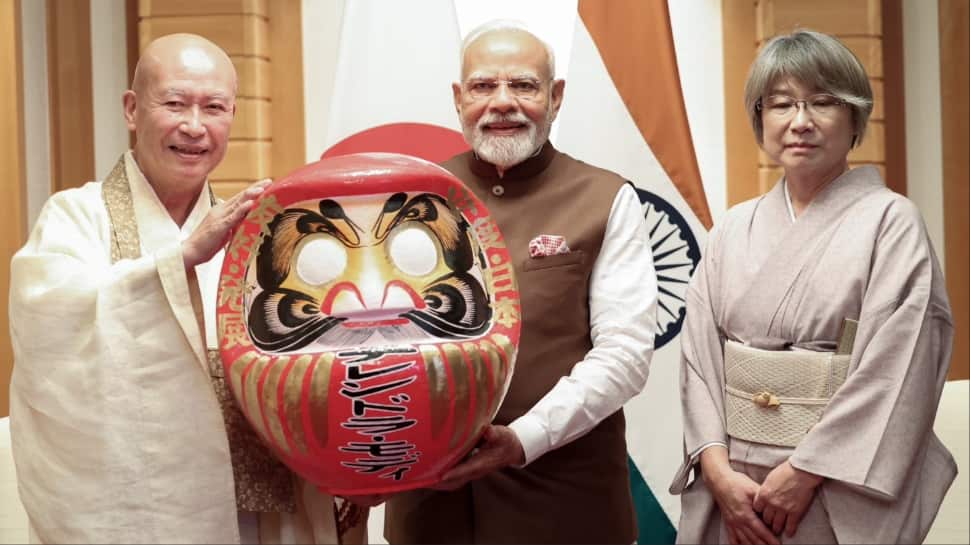
New Delhi: Prime Minister Narendra Modi, during his two-day official visit to Japan for the 15th India-Japan Annual Summit, received a symbolic and culturally significant gift, a traditional Daruma. More than just a handcrafted figure, the Daruma carries centuries of history, deep spiritual meaning, and a surprising connection to India. Rooted in the life of a South Indian monk who profoundly influenced East Asian Buddhism, the Daruma has evolved into one of Japan’s most powerful symbols of resilience, goal-setting, and good fortune.
What Is Daruma?
A Daruma is a traditional Japanese craft resembling a round, red, hollow figure with a painted face and no arms or legs. It symbolises Bodhidharma, known as Daruma in Japanese, a 5th-century monk credited with founding Zen Buddhism. Legend says he meditated for so long that he lost the use of his limbs, which is why the doll has a limbless form.
Designed to return upright when tipped over, the Daruma embodies resilience and is widely regarded as a symbol of good luck.
How Are Daruma Dolls Used?
According to Japanese custom, when someone sets a goal or makes a wish, they purchase a Daruma and paint in one eye while expressing their intent. Once the goal is achieved, the second eye is filled in to mark its fulfilment. These dolls are cherished in homes, businesses, and temples as reminders of perseverance and ambition.
Colours And Meaning
Though available in various colours today, the traditional Daruma is red, reflecting Bodhidharma’s red robes. In East Asian cultures, red is associated with prosperity, good fortune, and success. For instance, during Chinese New Year, red envelopes containing money are given as lucky gifts.
How They’re Made
Daruma dolls are crafted using papier-mâché and glue. Hollow and weighted at the base, they resemble a roly-poly toy, toppling over but always returning upright. This design captures the spirit of persistence.
Symbolism And Lessons
The Daruma’s ability to right itself symbolises resilience, triumph over adversity, and determination. It’s closely tied to the Japanese proverb “Nanakorobi yaoki”, meaning “fall seven times, rise eight”, reminding people to persevere despite setbacks.
Indian Roots Of Daruma
The Daruma’s origins trace back to Bodhidharma, a monk born in Kanchipuram, Tamil Nadu, around 440 AD. He later travelled to China, where he established what would become Chan Buddhism (known as Zen in Japan).
According to tradition, he meditated for nine years, leading to the loss of use of his limbs, an idea reflected in the design of the Daruma. Its rounded, self-righting form mirrors both his discipline and the enduring spirit he embodied.
PM Modi In Japan
During the summit, Prime Minister Modi and his Japanese counterpart are expected to sign multiple agreements and Memoranda of Understanding (MoUs) to enhance cooperation in trade, investment, technology, infrastructure, energy, and innovation. Strategic discussions will focus on regional security, maritime cooperation, and QUAD initiatives, particularly regarding Indo-Pacific stability.
The leaders will also explore greater cultural exchange, people-to-people engagement, and collaboration in science and education.