

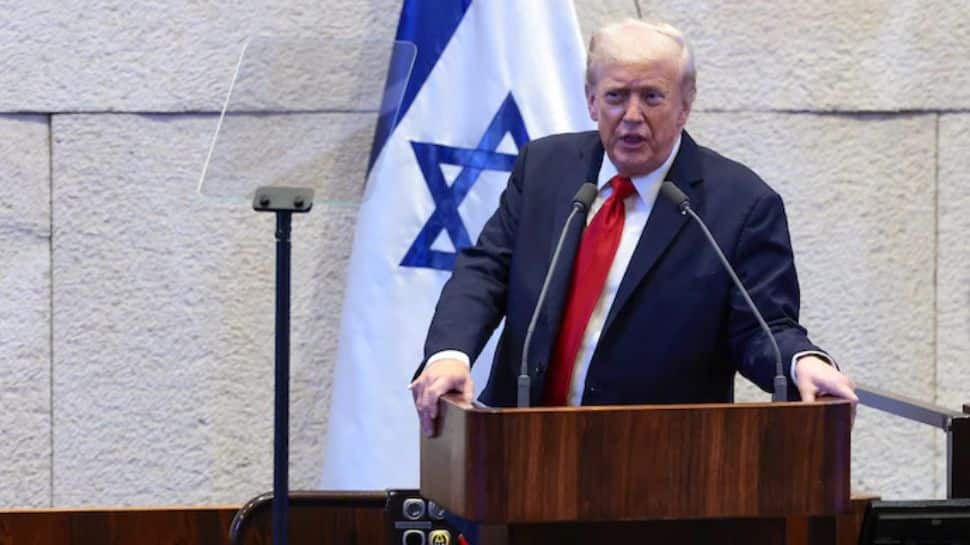
Who Abraham Was: US President Donald Trump repeatedly referred to Abraham during his speeches in Knesset (Israeli parliament) and Sharm el-Sheikh (Egypt) on the occasion of the Gaza Peace Summit, highlighting the 2020 Abraham Accords. These agreements established formal diplomatic ties between Israel and the United Arab Emirates, Bahrain, Sudan and Morocco. Beyond politics, Abraham represents a figure revered across three major religions, Judaism, Christianity and Islam. Understanding his life and legacy helps explain why he continues to hold such significance in religious and historical discussions.
Abraham is regarded as a patriarch in all three faiths, forming the foundation of what is collectively known as the Abrahamic religions. The Hebrew Bible, the Christian Bible and the Quran all describe his devotion to the same God and recognise him as a messenger. In Islam, he is known as Ibrahim. He is widely respected as a model of faith, obedience and devotion to God. Bruce Feiler, in his book ‘Abraham: A Journey to the Heart of Three Faiths’ writes that while each religion claims Abraham, he ultimately belongs to all. He also highlights the irony that despite this shared heritage, the followers of these faiths have often engaged in conflict.
According to the Hebrew Bible, God promised Abraham that he would become the father of a great nation, though he had no children at the time. He was sent on a journey to lands that now comprise Israel, Jordan and Gaza. From his servant Hagar, he had a son, Ishmael. Later, in a miraculous event, his elderly wife Sarah gave birth to Isaac. Hagar and Ishmael were eventually sent away, but after Abraham’s death, Ishmael visited Isaac to pay respects to his father one final time.
The Book of Genesis in the Hebrew Bible, also part of the Christian Old Testament, details Abraham’s life. He lived around 2,000 years before Jesus in Mesopotamia and near Haran, eventually travelling to Canaan. God promised that Abraham’s descendants would become a great nation. Abraham’s grandson, Jacob, is considered the progenitor of the Jewish people, as his sons established the tribes of Israel in Canaan.
Christian tradition traces Jesus Christ’s lineage to Abraham. In Islam, Prophet Muhammad is considered a descendant of Abraham’s son Ishmael. Through these connections, Jews, Christians and Muslims all recognise Abraham as a common ancestor and as God’s messenger. Muslims also believe that their spiritual history begins with Adam, culminating in Prophet Muhammad.
Jerusalem remains a focal point of Abrahamic reverence and dispute. Christians believe Jesus was crucified and resurrected here, with the Church of the Holy Sepulchre marking the site. Muslims revere the Al-Aqsa Mosque and the Dome of the Rock, linked to Prophet Muhammad’s night journey and ascension (Shab-e-Meraj). Jews regard Jerusalem as the location of the ancient Temple, where Abraham prepared to sacrifice Isaac and where the Western Wall remains a sacred site.
Israel was established in 1948 and took control of East Jerusalem in 1967, declaring the city its undivided capital, while Palestinians claim East Jerusalem as its own. This dispute continues to have religious and political significance.
Abraham’s legacy bridges faiths and history. His story explains why Jews, Christians and Muslims all honour him as a forefather and messenger, and why leaders invoke his name to emphasise shared heritage, dialogue and peace.