

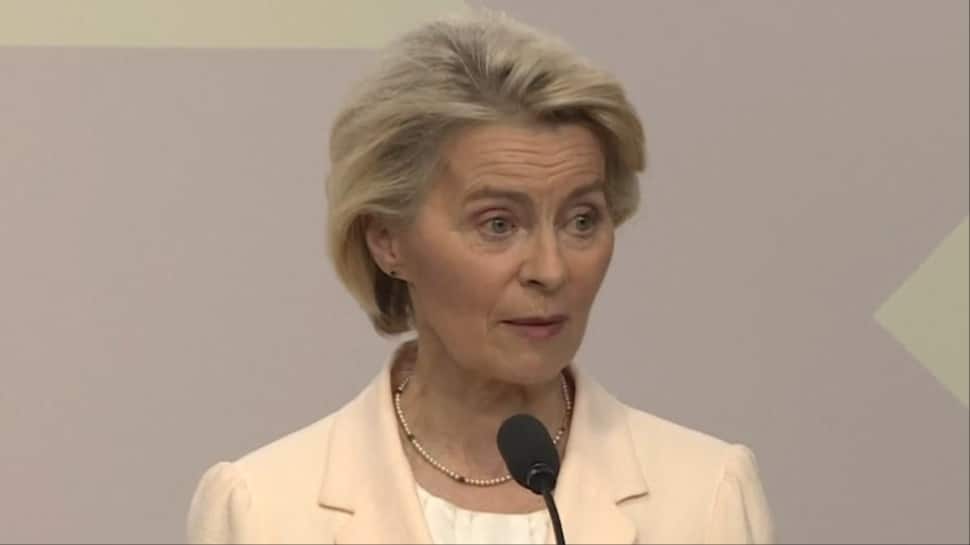
The state of Europe’s air defences has become a central topic at the informal European Union (EU) leaders’ summit in Copenhagen on Wednesday, 1 October, as concerns grow over repeated violations of its eastern airspace. On 10 September, just hours after Russian drones crossed into Polish territory, European Commission President Ursula von der Leyen proposed establishing a “drone wall” along the EU’s eastern flank. Since then, further incursions have underscored the urgency of such a defence system, yet details on how it would function remain vague, and doubts persist about its practicality.
Rising Tensions On Eastern Front
Von der Leyen’s concept currently lacks clarity on its scope, technical requirements, and financial implications, all likely to become contentious points in upcoming discussions. Nevertheless, the pressing need to bolster air defences along the EU’s eastern border with Russia is widely acknowledged.
Over the past two years, Russian aircraft have breached Polish airspace at least six times, including thrice since 20 August alone. Estonia has also reported four violations this year, the most recent on 19 September, which The Economist described as the most serious NATO airspace breach in two decades. Similar incursions have been noted in Lithuania, Norway, Sweden, Moldova, and Germany.
In September, Denmark and Norway faced a wave of drone intrusions that heightened security concerns just ahead of the summit, leading to temporary airport closures, such as a near four-hour shutdown at Copenhagen Airport on 22 September.
Danish Prime Minister Mette Frederiksen described Russia’s actions as a “hybrid war” against Europe. “The war in Ukraine is a Russian attempt to threaten all of us,” she said, urging European leaders to view Ukraine from a collective European rather than national perspective.
What ‘Drone Wall’ Would Entail
The proposed drone wall is not a physical barrier but rather an integrated defence system combining enhanced data sharing and a network of anti-drone technologies across frontline states. These could include advanced radar, acoustic sensors, electronic jamming devices, and possibly kinetic defences such as automated anti-aircraft guns or nets.
According to The New York Times, the objective is to establish a “joint shield” capable of detecting, tracking, and intercepting drones entering EU airspace or that of allied countries.
Cost-effectiveness will be critical. The rapid development and affordability of drones, which can be deployed in large swarms with numerous decoys, have rendered traditional missile-based air defences less efficient.
As NATO Secretary-General Mark Rutte noted, “We cannot spend millions of euros or dollars on missiles to take out the drones, which are only costing a couple of thousand of dollars.”
Instead, the drone wall is expected to rely heavily on electronic countermeasures, disrupting drones’ navigation and communications. Its success will depend on sophisticated coordination between drones and ground systems to distinguish genuine threats from decoys and to manage countermeasures effectively.
Funding And Political Hurdles
Russia shares a 2,250-kilometre land border with EU countries, including Finland, Estonia, Latvia, Lithuania, and Poland. Norway, an EEA member though not part of the EU, shares another 200 kilometres. Belarus, a close ally of Moscow, borders EU states for approximately 1,200 kilometres. Securing such an extensive frontier presents significant logistical and financial challenges.
At the Warsaw Security Forum on Monday, Germany’s Defence Minister Boris Pistorius cautioned that the drone wall project risks misallocating limited resources. “I very much appreciate the idea…but we should manage expectations,” he said. “This is not a concept that will be realised in the next three or four years.” He stressed the importance of focusing on “priorities” and enhancing current capacities.
French President Emmanuel Macron voiced similar reservations on Wednesday, telling reporters, “I’m wary of those kinds of terms. Things are a little more sophisticated.”
Such caution is common in EU defence cooperation, where national budgets remain the foundation. According to a January policy brief from the Centre for European Reform, ageing populations and sluggish economic growth make increasing defence spending challenging for many member states.
Consequently, major players like Germany and France, under considerable economic pressure, prefer to bolster their own military capabilities before committing to large-scale EU-wide defence projects.
An Ambitious, But Difficult, Goal
While the idea of a drone wall is ambitious and, to some, essential, realising it will require substantial political agreement on financing and implementation. Despite von der Leyen’s forceful advocacy, resistance from influential members such as France and Germany could prove a significant obstacle to progress.
As the EU seeks to respond to evolving security threats, the drone wall remains an urgent but complex proposal, one that demands careful deliberation, resources, and cooperation across the bloc.