

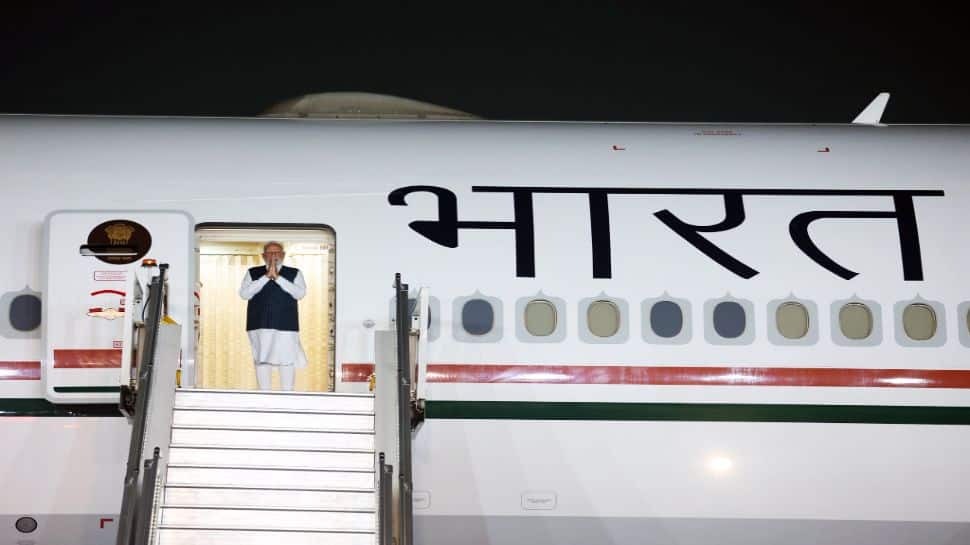
New Delhi: Prime Minister Narendra Modi embarked on a two-day visit to Japan on Thursday, marking his eighth official trip to the country. Anchored around the 15th Annual India-Japan Summit, the visit is being seen as a significant milestone in strengthening strategic, economic and technological cooperation between the two nations.
PM Modi is set to hold high-level talks with his Japanese counterpart, Shigeru Ishiba, with a special focus on QUAD, high-speed rail and the rapidly expanding semiconductor sector.
The summit is aimed at reinforcing the Indo-Pacific strategy through the QUAD alliance, comprising India, Japan, Australia and the United States. According to Foreign Secretary Vikram Misri, QUAD plays a vital role in ensuring peace, development and stability across the region.
Discussions during the visit are expected to revolve around public health, supply chains, critical technologies and infrastructure. Defence cooperation is also on the table, with both navies exploring partnerships in ship maintenance and technology.
Projects such as Unicorn Mast have already begun shaping the future of this maritime collaboration.
Over the next few days, will be in Japan and China to attend various bilateral and multilateral programmes. In Japan, will take part in the 15th Annual India-Japan Summit and hold talks with PM Shigeru Ishiba. The focus would be on deepening our Special Strategic and Global…
— Narendra Modi (@narendramodi) August 28, 2025
In China, I will take part in the SCO Summit in Tianjin, a forum where India has always played an active and constructive role. India will keep working with SCO members to address various shared challenges. I will also be meeting President Xi Jinping, President Putin and other…
— Narendra Modi (@narendramodi) August 28, 2025
One of the key highlights of the dialogue will be the Mumbai-Ahmedabad bullet train corridor. Japan has committed an investment of Rs 88,000 crore in this high-speed rail project. As per a Nikkei Asia report, Japan is poised to invest 10 trillion yen (approximately $68 billion) in India over the next decade, with a focus on artificial intelligence, semiconductors and medical innovation.
During the visit, PM Modi will tour the Tokyo Electron factory and the Shinkansen plant. Japan, in return, is expected to announce new opportunities for Indian professionals in the semiconductor industry.
Strengthening Ties Through ‘Triple T’ – Trade, Technology And Trust
In the wake of rising trade tensions between India and the United States, this visit carries critical economic and strategic weight. Both India and Japan are working to discover new avenues for trade, technological cooperation and investment. This engagement goes far beyond economics. It reflects a shared vision between two of Asia’s most prominent democracies to align on matters of global and regional significance.
The India-Japan relationship is built on deep-rooted trust and shared democratic values. Over the years, frequent high-level exchanges have brought the two countries closer. In 2007, former Japanese Prime Minister Shinzo Abe’s historic ‘Confluence of Two Seas’ speech in the Indian Parliament was a pivotal moment. It was followed by visits of Emperor Akihito and Empress Michiko to India in 2013, the first-ever visit by a Japanese monarch. Abe later attended India’s Republic Day as chief guest in 2014, while then President Ram Nath Kovind represented India at Emperor Naruhito’s enthronement in 2019.
ALSO READ: Japan Scraps US Trip Last Minute Ahead Of PM Modi’s Upcoming Bilateral Summit
In recent years, Japanese Prime Minister Fumio Kishida pledged to invest 5 trillion yen (around $42 billion) in India, with a focus on clean energy and industrial competitiveness. Modi’s consistent participation in Japan’s diplomatic dialogues, including the 2023 G7 Summit in Hiroshima and the G20 Summit in New Delhi, reflects an active and evolving partnership. Their meetings in Italy and Laos in 2024 further solidified this connection, proving that Japan is not just a regional partner, but a long-term strategic ally.
Pillars Of The India-Japan Partnership
1. Strong Investment Confidence: Japan ranks as India’s fifth-largest source of foreign direct investment (FDI), with investments surpassing $43 billion as of December 2024.
In the past two years alone, over $13 billion worth of agreements have been signed in sectors such as steel, electric vehicles, semiconductors and renewable energy.
2. Supply Chain Resilience: Both countries are moving to reduce dependency on China through the Supply Chain Resilience Initiative, focusing on critical sectors like semiconductors, rare earth elements and EV batteries.
3. Technology Transfer: Japanese giants like Toyota, Suzuki and Nippon Steel are setting up advanced facilities in India. These ventures are helping small and mid-sized Indian firms become part of the global supply chain while raising the quality of exports.
4. Clean Energy and Sustainability: Projects such as Osaka Gas’s green hydrogen initiatives and biogas plants in Gujarat are contributing to rural development and environmental goals.
Expanding Horizons: Infrastructure To Innovation
The summit between Modi and Ishiba aims to enhance cooperation in areas like economic security, clean energy and digital technology. Since 1958, Japan has been India’s largest development partner. Its contributions include major infrastructure projects such as the Mumbai-Ahmedabad bullet train, urban metro systems and several smart city initiatives.
In FY 2023-24, India received $4.5 billion in official development assistance from Japan.
Bilateral trade between the two countries reached $22.8 billion last year. Machinery and steel remained the top imports. At present, nearly 1,400 Japanese companies operate around 5,000 units in India, while over 100 Indian firms are active in Japan.
The year 2025-26 has been declared as the Year of Science, Technology and Innovation Exchange. Focus areas will include AI, robotics, semiconductors and space technology through collaborations such as ISRO-JAXA.
Human Capital, Demography And Education: A Complementary Partnership
The partnership between India and Japan is shaped not just by geopolitics or trade, but also by demographic complement. Japan faces an aging population and labor shortages. India offers a massive pool of young professionals. This naturally leads to skill-based cooperation.
Over 665 academic collaborations exist between Indian and Japanese universities. Through initiatives like Edu-Connect, Talent Bridge and Skill Connect, the aim is to facilitate the exchange of 50,000 students and professionals over the next five years. Key sectors include AI, semiconductors, robotics and clean energy.
Japanese companies are recruiting Indian engineers for their global R&D hubs. Fujitsu plans to hire 9,000 engineers. Nidec is setting up a software centre in Bengaluru, and Musashi Seimitsu is developing EV parts with Indian graduates. Training initiatives like the Technical Intern Training Program (TITP) and the Specified Skilled Worker (SSW) scheme are preparing Indian youth for Japanese industries. To support this, Japanese firms are investing in language and cultural integration programmes.
Defence, Security And Strategic Vision
India and Japan are working closely to synchronise their Indo-Pacific strategies. India’s ‘Act East’ and the Indo-Pacific Oceans Initiative (IPOI) align with Japan’s Free and Open Indo-Pacific (FOIP) vision. Both are key QUAD members and conduct joint military drills such as Malabar, JIMEX and Dharma Guardian.
ALSO READ: ‘I Never Said Someone Should Retire At…’: RSS Chief Mohan Bhagwat On 75-Year Age Limit For Leaders
Defence agreements like the 2020 Logistics Support Agreement and the 2024 Unicorn naval mast co-development project are strengthening mutual trust. The regular 2+2 dialogue format has further positioned Japan as a crucial defence partner for India.
Cultural Diplomacy And People-To-People Ties
Culture remains a foundation of bilateral relations. The 2023-24 Tourism Exchange Year symbolically connected the Himalayas with Mount Fuji. The unveiling of Mahatma Gandhi’s statue in Hiroshima highlighted shared values of peace. Around 54,000 Indians, mostly professionals and engineers, live in Japan and serve as a bridge between the two nations.
Why This Visit Matters
Prime Minister Modi’s visit to Tokyo is a reflection of India’s commitment to building resilient partnerships in Asia. Japan’s expertise in technology and its readiness to invest aligns perfectly with India’s demographic strength and expanding market. Projects like the Shinkansen rail corridor, semiconductor collaborations, biogas plants and student exchanges are not only driving growth but also shaping the Indo-Pacific’s strategic future.
In the current global environment of shifting alliances and trade uncertainties, particularly with rising U.S. tariffs, Japan is emerging as a dependable and long-term partner for India. Modi’s visit marks another chapter in a relationship defined by shared values, mutual interests and a future-oriented vision.