

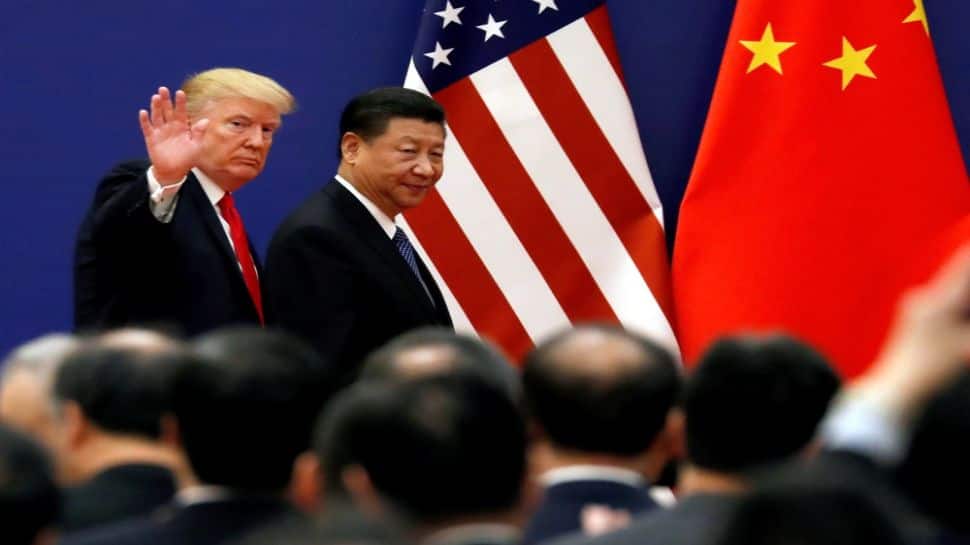
Trump-Xi Meeting: When US President Donald Trump and Chinese Premier Xi Jinping sit down at Busan in South Korea, the table will hold far more than trade deals and tariff disputes. A question echo in the diplomatic corridors across Washington, Ukraine and Russia: can Beijing help stop the war in Ukraine?
Inside Kyiv’s military workshops, the war has become inseparable from Chinese technology. Engineers admit that nearly every component inside a frontline drone (from cameras and chips to fiber optics) can be traced back to factories in Shenzhen or Guangdong.
Ukrainian defense experts say that if Beijing decided to restrict those exports tomorrow, both Moscow and Kyiv would feel the shock instantly.
Chinese factories, according to Ukrainian intelligence estimates, supply nearly 80 percent of the drones, circuits and dual-use electronics sustaining Russia’s battlefield operations. The flow of components has given Moscow’s army a vital technological cushion, helping it offset Western sanctions.
Aware of this leverage, Trump now wants to pull Beijing into his diplomatic chessboard. Before leaving for South Korea, he told aides that he wants China’s help “with Russia”, a remark that signalled his hope that Xi might quietly press Vladimir Putin toward the negotiating table.
For Trump, who cancelled his own talks with his Russian counterpart just days earlier, the Busan summit offers a chance to reposition the United States as the power capable of brokering peace through China. His team believes that Beijing’s hold over Moscow’s trade and tech lifelines could prove decisive if Xi chooses to use it.
Ukraine’s leadership sees the same possibility. President Volodymyr Zelenskyy has urged Washington to push Beijing toward cutting energy deals with Russia, saying that if Chinese imports of Russian oil and gas decline, “it will help us all”. Kyiv views China’s economic weight as the one lever that could truly pressure the Kremlin.
But behind that hope lies a geopolitical paradox. Beijing’s purchases of cheap Russian oil, gas and raw materials have helped cushion Moscow’s war economy. Analysts in Ukraine say that if Trump’s new sanctions, which target Russian energy giants Rosneft and Lukoil, shrink Moscow’s global footprint, Chinese state firms could fill the vacuum, expanding Beijing’s reach into Central Asia and Africa.
For Xi, that outcome may be more valuable than any symbolic peace gesture. Experts close to Ukrainian policymaking circles say that without China’s financial backing and trade access, Russia’s war machine would grind to a halt. But they also say that Beijing has little reason to hand Trump a diplomatic victory, especially when tensions over trade, semiconductors and Taiwan are already straining ties.
Beijing insists that it remains neutral in the conflict. Official statements describe China as a “responsible power” calling for peace while strengthening its economic cooperation with Russia behind closed doors. Its strategists see long-term benefit in maintaining the current stalemate: a weakened but surviving Russia keeps Western attention divided and NATO resources stretched.
The logic of “freezing the war” now appeals to both Beijing and Washington. Analysts in Kyiv say neither side wants Moscow to achieve an outright victory that would embolden Putin, nor a complete defeat that could destabilise China’s vast northern borders. A controlled stalemate, one that prevents escalation but allows diplomacy to move slowly, may be the unspoken goal of both capitals.
For Ukraine, that scenario is dangerous. A frozen war means waiting for Russia to rebuild, rearm and return. To guard against that, Kyiv has been strengthening its ties with the European Union, Turkey and even Pakistan (nations that can balance their relationships with both the West and Beijing).
Putin, meanwhile, is preparing his own offers. He is believed to be floating ideas for joint Arctic trade routes, expanded energy pipelines and even nuclear fuel cooperation – proposals that could appeal to both Washington and Beijing after the war.
For Trump, success at Busan will depend on whether Xi believes that ending the war aligns with China’s long game. For Xi, the choice is more strategic than moral: weigh the benefits of peace against the power of influence.
If China were to close its factories’ doors to Russia’s supply lines, the war could lose its engine in weeks. But if it keeps them open, Trump’s quest for a quick peace may end as just another headline.
Either way, when the two leaders meet in Busan, the world will be watching to see if the road to peace in Ukraine runs, even quietly, through Beijing.