

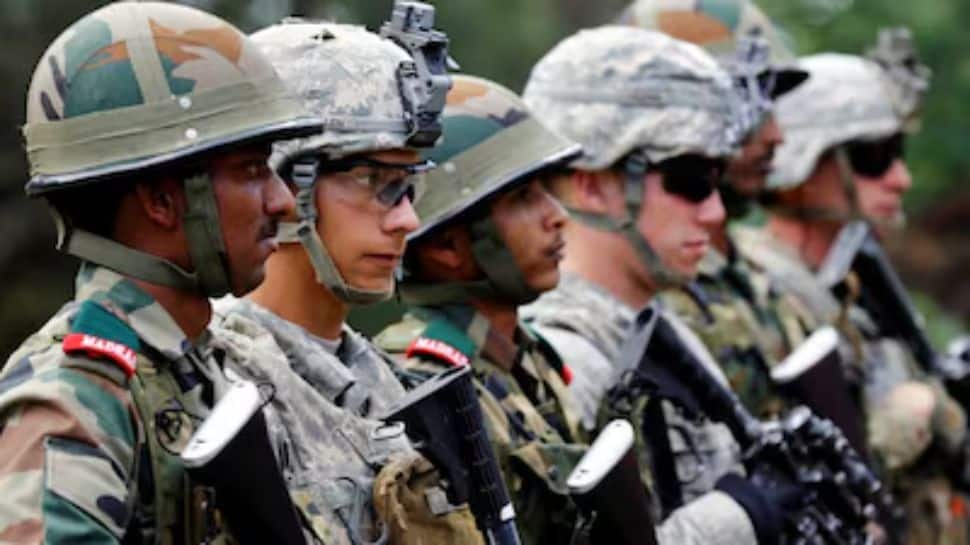
New Delhi: US President Donald Trump, speaking at the Gaza peace summit in Egypt’s Sharm El-Sheikh on Monday, emphasised the unparalleled strength of the American military. While Washington wields significant global influence, the largest armies by manpower are in China and India, with the latter ranking fourth overall in military power according to the Global Firepower Index 2025.
The ranking assesses countries on active personnel, defense budgets, technological edge and strategic capabilities. Military strength shapes global security, guides diplomacy and enables nations to assert their strategic priorities.
Unmatched Global Reach
Backed by cutting-edge technology and a colossal defense budget, the US military continues to hold the world’s foremost influence. It maintains approximately 1.3 million active personnel, with the 2025 defense allocation exceeding $877 billion. This funding supports nuclear arsenals and advanced command structures, including US Central Command, Indo-Pacific Command and Cyber Command.
Stealth bombers such as the B-2 and B-21, F-35 fighter jets, world-class drones and satellite warfare capabilities reinforce America’s strategic edge. With over 800 bases across the globe, the United States commands unmatched reach in air, land, sea and space operations.
Strategic Power, Economic Strains
Russia maintains its position as the world’s second-most powerful military. With nearly 1 million active personnel and an estimated $100 billion defense budget, it commands the largest nuclear arsenal globally.
Its technical strengths include hypersonic missiles such as Avangard and Zircon, advanced air defense systems like the S-400 and S-500, formidable artillery and armoured divisions and sophisticated cyberwarfare capabilities.
Modernised And Expansive
China’s People’s Liberation Army (PLA) has pursued aggressive modernisation, prioritising high-tech warfare, naval expansion and strategic deterrence.
With around 2 million active personnel, it is the world’s largest standing army. The 2025 defense budget is estimated at $350 billion.
Beijing maintains a nuclear arsenal and a diversified force structure, including the PLA Ground Forces, Navy (PLAN), Rocket Force and Strategic Support Force. Its navy leads globally by number of ships, reinforced by advanced drones and sophisticated cyberwarfare capabilities.
Second-Largest Army
India ranks among the world’s most powerful nations, combining vast manpower with nuclear capability, advanced missile systems and rapidly modernising forces. Its active military strength is approximately 1.45 million, supported by a 2025 defense budget of around $80 billion.
New Delhi’s nuclear arsenal is complemented by integrated command structures across the Army, Navy, Air Force and Strategic Forces. Its troops are trained for diverse terrains, from high-altitude regions to deserts and equipped with indigenous systems such as BrahMos missiles, Tejas fighter jets and INS Vikrant.
Strategic partnerships with the United States, France, Russia and Israel further bolster its global military profile. South Korea ranks fifth on the index.
Regional Tensions Affect Rankings
India’s Global Firepower Index score of 0.1184 reflects sustained investment, modernization and manpower strength. While benefiting from Chinese support in material acquisitions, Pakistan has faced setbacks due to recent border clashes with Afghanistan. These tensions have negatively impacted Islamabad’s ranking, placing it 12th with a score of 0.2513.
The Global Firepower Index 2025 highlights how military strength shapes global influence. Advanced technology, strategic alliances and operational readiness determine which nations can project power and secure their interests in a complex international environment.