

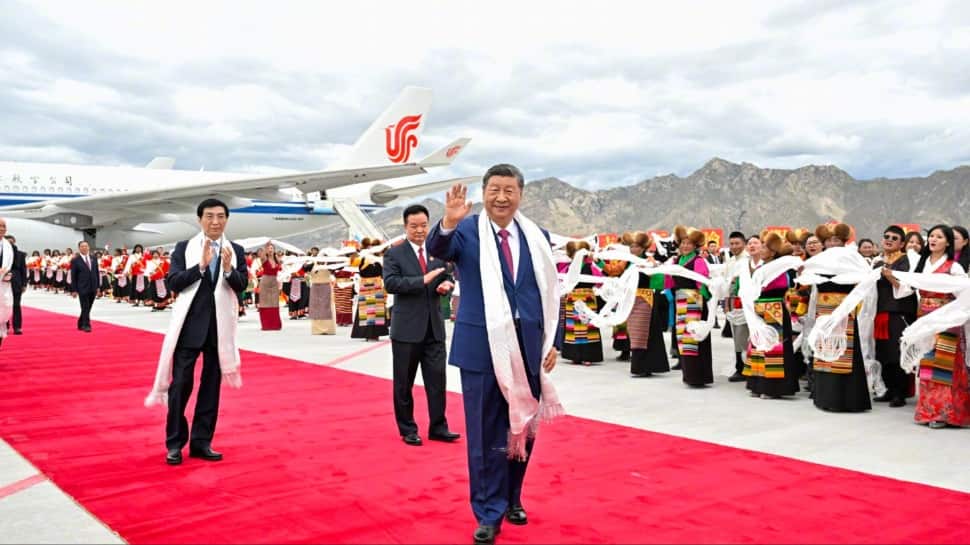
Chinese President Xi Jinping visited Tibet on Wednesday, a region where Beijing has been accused of human rights abuses. Xi called for ethnic unity and “religious harmony” on his trip, in a visit with increased sensitivity as regards the succession of the 90-year-old Dalai Lama.
Historical Context And Geopolitical Dispute
Xi’s tour is especially meaningful in light of the historic China-Tibet conflict. Tibetans and foreign onlookers often see Tibet as having long been an autonomous country, whereas China argues Tibet has been part of its land for centuries.
Tibet proclaimed de facto independence in 1913 following the collapse of the Qing Dynasty by the 13th Dalai Lama. Yet the People’s Republic of China (PRC), founded in 1949, asserts sovereignty over the state on the basis of past claims and the principle of territorial integrity. Tibet was formally constituted as an autonomous region in 1965, six years after the 14th Dalai Lama went into exile in India, where he set up a Tibetan government in exile.
North Korea vibes: Xi Jinping arrived in Lhasa, Tibet’s capital, on Aug 20, together with Wang Huning and Cai Qi, for the 60th anniversary of the establishment of the Tibet Autonomous Region.https://t.co/a8qZl4tfP6 pic.twitter.com/eqTL5zodmQ
— Byron Wan (@Byron_Wan) August 20, 2025
Xi’s Message: Stability And “Sinicization of Religion”
This is Xi Jinping’s first trip to Tibet since 2021. China’s state TV, CCTV, reported Xi telling Tibetan officials, “To govern, stabilise and develop Tibet, we must first safeguard political stability, social stability, ethnic unity, and religious harmony.”
Images during the trip captured huge crowds, which CCTV estimated at about 20,000 people, including soldiers and schoolchildren, mostly in traditional Tibetan attire, waving red flags with enthusiasm and cheering as a bus Xi was travelling in drove by. A parade, which included Tibetan dancers, floats with official posters, and troop formations, also took place.
Interestingly, CCTV’s coverage of Xi’s speech made no reference to the Dalai Lama. Instead, Xi urged “guiding Tibetan Buddhism to adapt to socialist society in accordance with the systematic Sinicization of religion,” a policy designed to bring religions under the party’s control.
Dalai Lama Succession And Dam Project
Xi’s trip comes only weeks after the Dalai Lama declared his spiritual institution would endure beyond his death, with his successor chosen “exclusively” by his office. China, however, maintains the new Dalai Lama must be vetted by the government in Beijing, leading to the possibility of tensions.
Aside from religious and ethnic policy, Xi also gave his backing to the “orderly, vigorous, and efficient” construction of the enormous Yarlung Tsangpo dam, a major infrastructure project that broke ground in July.
ALSO READ | How Did FBI’s 4th Most Wanted Fugitive, Cindy Singh, Get Caught In India After Months On The Run?