

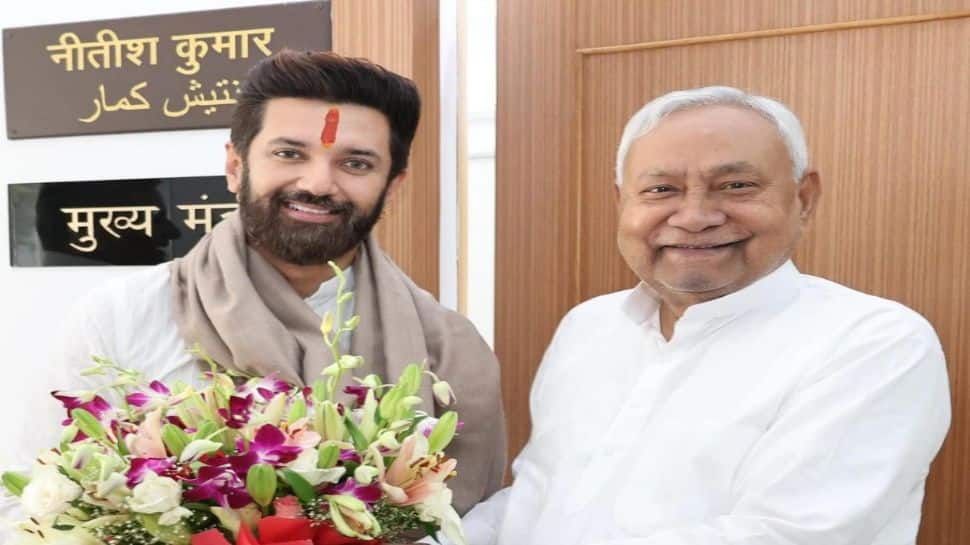
Patna: Ever since the Bharatiya Janata Party (BJP)-led National Democratic Alliance (NDA) announced its seat-sharing formula for the upcoming Bihar Assembly elections, all eyes have been on Union Minister Chirag Paswan’s much-hyped “strike rate”. His party, the Lok Janshakti Party (Ram Vilas) or LJP (R), walked away with 29 assembly seats this time. Many believe his track record in the previous elections convinced the BJP to reward him so generously. But the real story behind Chirag’s strike rate is far more layered than it appears.
Party insiders say discontent runs deep among NDA partners. Soon after the seat-sharing announcement, JD(U) leader and Chief Minister Nitish Kumar, Hindustani Awan Morcha (HAM) leader and Union Minister Jitan Ram Manjhi and Rashtriya Lok Morcha (RLM) chief Upendra Kushwaha expressed frustration over the allocation of seats, especially those given to Chirag’s LJP (R).
On the night of October 13, Nitish held JD(U)’s core committee meeting at his residence in Patna, where he strongly objected to giving the Sonbarsa and Rajgir seats to Chirag’s party. JD(U) treasurer Lalan Saraf later confirmed that minister Ratnesh Sada would contest Sonbarsa for the JD(U).
Meanwhile, the BJP held separate talks with Nitish and maintained publicly that “all is well” within the NDA.
Kushwaha hinted at his displeasure in a cryptic X post, “Today, the clouds conspired again, raining where my home is….” However, he later clarified that the seat-sharing issue had been “resolved through cordial talks”.
Manjhi too expressed disappointment, saying, “Yes, we got fewer seats. Our workers are demoralised, but I will not push Bihar toward chaos.”
Union Minister Giriraj Singh added fuel to the fire by posting on X, “This is the real strike rate. Today, they are boasting about strong seats, but in 2010, the NDA made history by winning 206 out of 243 seats.”
This time, the NDA’s five allies, the BJP, the JD(U), the LJP (R), the HAM and the RLM, divided the 243 seats with the BJP and JD(U) getting 101 each, the LJP (R) 29 and the HAM and the RLM six each. Most resentment centres around the 29 seats given to the LJP (R).
Since the 2024 Lok Sabha elections, Chirag has repeatedly highlighted his “perfect strike rate” as proof of his political clout in media interviews, saying the NDA gave him five seats in the general elections, he won all five, and now he expects a fair share of seats in return.
He reportedly used that success to pressure the BJP for more seats, a move that did not sit well with many senior NDA leaders.
But data tells a more nuanced story. Chirag’s performance has historically been strong only when Nitish Kumar is part of the NDA. In the 2014 Lok Sabha elections, the LJP (R) (R) fought seven seats with the BJP and won six, when Nitish was not part of the BJP-led alliance. In the 2015 Bihar Assembly elections, the LJP (R) again fought with the BJP on 42 seats but won only two, still without Nitish.
In 2019, when Nitish returned to the NDA, leaving Mahagathbandhan (a coalition of the Rashtriya Janata Dal or RJD, the Congress and Left parties), the LJP (R) contested six seats and won all of them. But in the 2020 assembly elections, when Chirag went solo, the LJP (R) contested 135 seats and managed to win just one.
A deeper look at the numbers tells more. The six Lok Sabha seats that the LJP (R) won in 2019 together included 36 assembly constituencies. In 2020, the party contested 135 assembly seats, including 28 from those 36. Out of those 28, the LJP (R) came third in 21 and fourth in seven, while the NDA won 19.
In the 2024 elections, the LJP (R)’s five Lok Sabha seats cover 30 assembly constituencies. Of these 30, the NDA had won 17 in 2020, and the LJP (R) did not finish second in any.
So why does Chirag still matter so much? It is because of his community base. The Paswans (Dusadhs), a Mahadalit group, make up 5.31% of Bihar’s population and can influence 20-25 assembly seats. In 2020, Chirag’s party secured over 10,000 votes in 90 out of 135 seats, totalling nearly 2.4 million votes.
Chirag himself said last year, “I play the role of salt in the alliance. Without salt, no dish tastes right.”
Analysts agree. His party’s vote share may have halved over two decades, but it remains decisive in tight races. In 2020, the LJP (R)’s vote-cutting impacted at least 35 seats where victory margins were below 3,000 votes.
BJP insiders say this is exactly why Delhi leaders trust Chirag, and not Nitish, to deliver key seats. On October 7, BJP election observer Dharmendra Pradhan met Chirag in Delhi to finalise the seat-sharing deal, bypassing Nitish’s input.
Analysts say the BJP’s reduced trust in Nitish is rooted in his political flip-flops, breaking with the BJP in 2013, joining the Mahagathbandhan in 2015, returning to the BJP in 2017, leaving again in 2022 and coming back once more in 2024.
That is why, in today’s Bihar politics, Chirag’s “strike rate” is not merely about numbers, it is about trust, timing and Delhi’s power play. His stats may not always tell the full truth, but for now, Chirag Paswan remains the NDA’s most bankable bet in a state where every seat counts.