

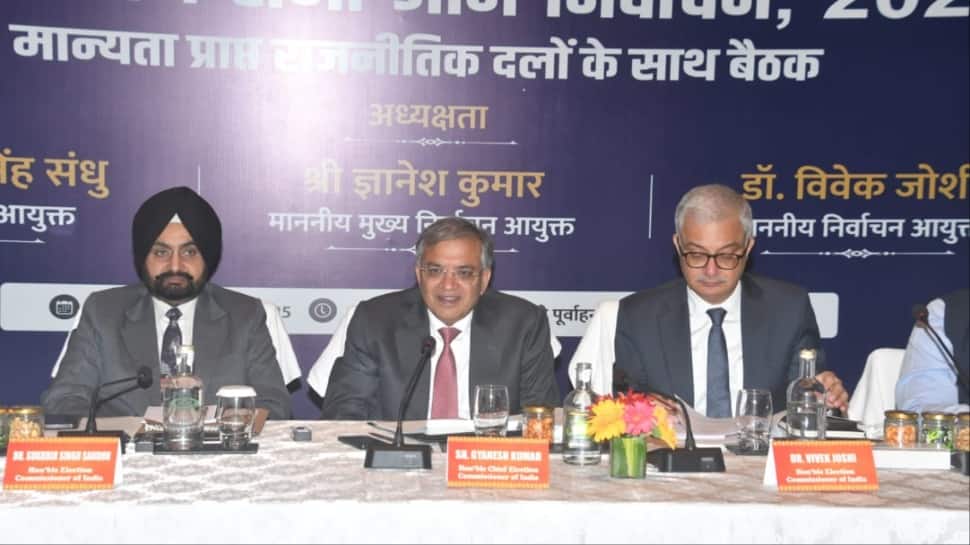
As preparations intensify for the high-stakes Bihar Assembly elections, the Election Commission of India (ECI) is continuing its in-depth two-day review of the state’s election preparedness to ensure free, fair, and transparent polling.
On Sunday, the second day of its visit, the ECI team, headed by Chief Election Commissioner Gyanesh Kumar, is holding a series of critical meetings in Patna with enforcement and regulatory agencies to tackle long-standing electoral challenges in the state, particularly the misuse of money and muscle power.
The Commission is engaging with senior officials from the Income Tax Department, police, and other enforcement bodies to evaluate existing action plans. The aim is to strengthen inter-agency coordination, boost surveillance, and implement focused strategies to uphold the integrity of the electoral process.
Later in the day, the Commission will hold strategic meetings with the Chief Electoral Officer, the State Police Nodal Officer, and representatives of central security forces to assess operational preparedness. This will be followed by a high-level review of overall state-level coordination with the Chief Secretary, Director General of Police, and other senior bureaucrats.
The ECI will also hold a press conference at 2 p.m. today to brief the media on key developments. The briefing will include a summary of the preparedness reviewed so far, feedback received from political parties, and an outline of the roadmap ahead.
On Saturday, the ECI team, comprising CEC Gyanesh Kumar and Election Commissioners Dr. Sukhbir Singh Sandhu and Dr. Vivek Joshi, held wide-ranging consultations with representatives of major national and regional parties, including BJP, Congress, JD(U), RJD, LJP (Ram Vilas), RLJP, CPI, CPI(M), CPI(ML-Liberation), BSP, AAP, and NPP.
Calling political parties “significant stakeholders of a strong democracy”, the Commission urged them to engage actively in the electoral process by appointing polling and counting agents. It also encouraged all parties to celebrate elections festively and inclusively.
Political parties, while appreciating ECI’s efforts in completing the Special Intensive Revision (SIR) and cleansing the electoral rolls, requested that elections be scheduled soon after the Chhath festival and conducted in fewer phases to boost voter turnout. They also welcomed reforms like capping electors per polling station at 1,200, timely postal ballot counting, and the mandatory handover of Form 17C to party agents post polling.
(With inputs from IANS)