

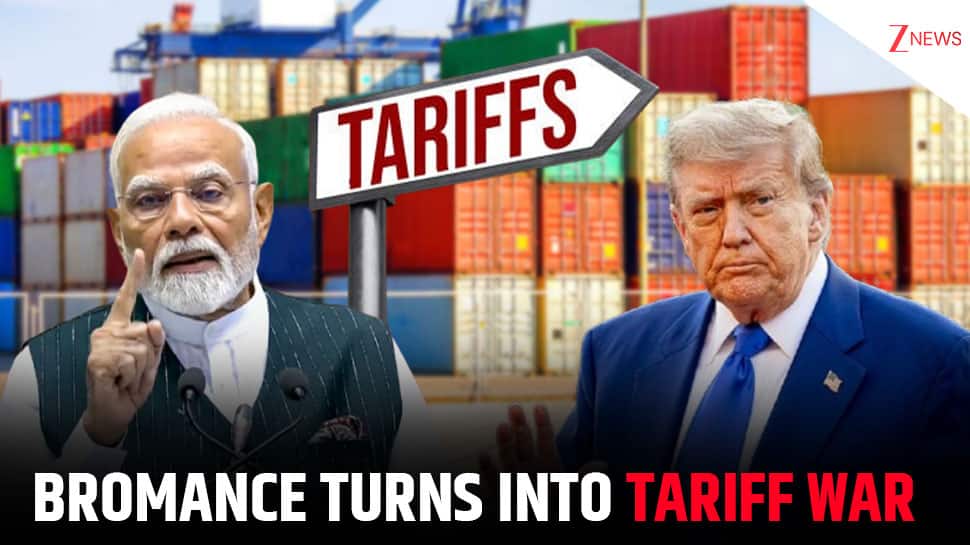
India-US Tariff Tensions: What once looked like a diplomatic success story is now falling apart fast. Tensions between India and the United States have erupted publicly, with New Delhi pushing back hard against President Donald Trump’s threat to hike tariffs on Indian goods in response to its continued purchase of Russian oil. India has called the move ‘unjustified and unreasonable’, accusing Washington of hypocrisy and double standards.
The so-called Modi-Trump bromance, built on stadium events and mutual praise, is collapsing under the pressure of real politics. The grand gestures of ‘Howdy Modi’ in Houston and ‘Namaste Trump’ in Ahmedabad have given way to sharp accusations, economic penalties, and diplomatic chill.
India Misread Trump’s Doctrine
At the heart of the fallout lies a fundamental miscalculation by New Delhi: mistaking Trump’s flattery for friendship. Prime Minister Modi banked heavily on personal diplomacy, believing his warm ties with Trump could translate into long-term strategic gains. But Trump doesn’t separate diplomacy from business, and friendship doesn’t count when personal interests are on the table.
India misread the moment. Trump’s public displays of camaraderie were always about optics, not alignment. His admiration did not shield India from his America-first trade policies, and Modi’s gamble on personal chemistry has yielded little protection from economic confrontation.
Worse still, from Varanasi to Gujarat, India celebrated Trump’s leadership, with public prayers, temple rituals, and village ceremonies backing his re-election. Yet Trump has made it clear: there are no friends in his playbook, only deals to be made or broken.
Russian Oil: The Breaking Point?
India’s decision to ramp up imports of discounted Russian crude, now constituting around 40% of its oil supply, has become the latest flashpoint. With global oil prices unstable and alternative supplies redirected to Europe amid the Ukraine conflict, India turned to Moscow out of necessity, not ideology.
Trump, however, has framed the move as undermining Western unity and aiding Putin. In retaliation, he opted for tariffs, framing India as a country profiting from geopolitical instability.
New Delhi has rejected this characterisation outright. In a firm statement on 4 August, the Ministry of External Affairs argued that India’s energy choices are grounded in economic survival, not sympathy for Moscow. It also accused the US and Europe of duplicity, pointing to their ongoing trade with Russia in sensitive sectors such as uranium and fertilisers.
Tariff Hammer, Trade, And Tilt To Pakistan
The imposition of a 25% tariff on Indian exports is more than an economic weapon; it is a signal. Trump’s long-standing grievances with India over market access, regulatory barriers, and trade imbalances have resurfaced. In 2024, the US trade deficit with India stood at $45.7 billion, a figure Trump treats as proof of exploitation.
To compound matters, Trump has begun to warm up to Pakistan once again, holding military-level talks and proposing energy cooperation. For Indian policymakers, who believed Trump had decisively pivoted away from Islamabad, the shift feels like a strategic betrayal.
Trump’s Nobel Ambition: India A Breaker?
The rupture with India also complicates a broader personal mission of Trump. The US president is said to harbour a long-standing ambition to win the Nobel Peace Prize. Trump has often floated the idea that his diplomatic overtures, from North Korea to the Middle East, merit international recognition. Five countries, including Israel and Canada, have backed Donald Trump’s name for the Nobel Prize.
The US President also claimed that once he comes to power, he would stop the Russia-Ukraine war on the very first day of his tenure. But this came out to be a hollow remark, as even after his 200 days in the post, the war is still on.
But India, once seen as a potential pillar in a Trump-led reordering of global power, is now emerging as an obstacle. This follows Trump’s claim of becoming a mediator of the India-Pakistan ceasefire and PM Modi’s claim that “no global leader” endoursed India-Pakistan’s Ceasefire. The snub reportedly embarrassed the US President and forced him to rethink his so-called bromance, especially with his Nobel hopes at stake.
Time For Real Strategy
India now faces a tough reality: personal diplomacy does not equal strategic security. Trump is not a friend; he’s a negotiator. He respects strength, not sentiment.
It’s time for New Delhi to drop the pageantry and focus on policy. The future lies not in stadium shows and symbolic partnerships, but in hard talks, quiet deals, and clear-eyed realism. Rather than chasing handshakes and headlines, India must act not as a junior ally seeking validation, but as a sovereign power defending its interests in a competitive world.
The era of symbolic diplomacy is over. What’s needed now is cold, calculated negotiation, not stagecraft, but statecraft. The big lesson? Never tie a national strategy to one leader’s favour. Trump didn’t come to dance; he came to deal. And if India wants to stay in the game, it’s time to play tough.