

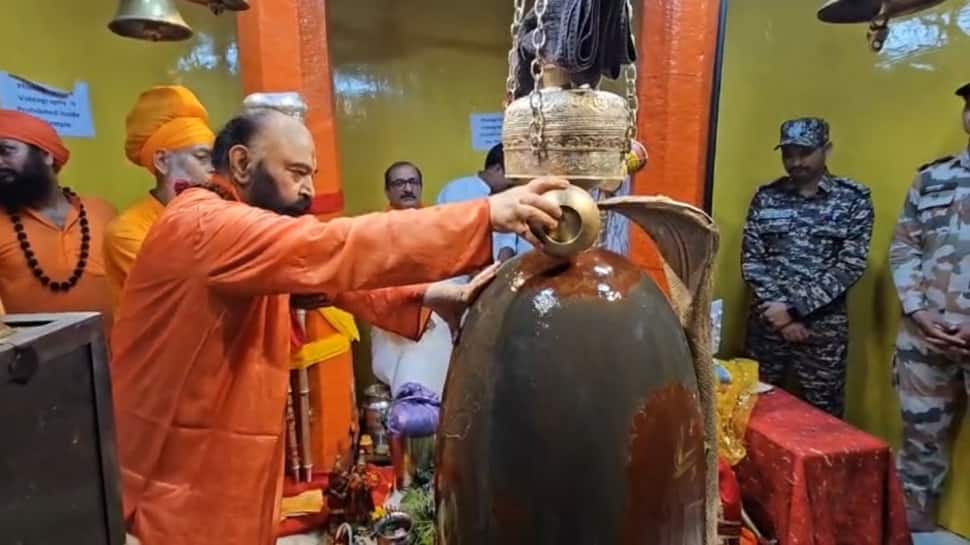
On the sacred occasion of Haryali Amavasya, the Chhari Mubarak Puja – an important ritual associated with the Amarnath Yatra – was conducted at the ancient Shankaracharya Temple in Srinagar. The Chhari Mubarak comprises two sacred silver maces, revered as physical embodiments of the divine couple – symbolising the presence of Lord Shiva and Goddess Parvati.
Apart from this temple, it is carried in a ceremonial procession to various temples of Kashmir during the Amarnath Yatra, and then finally on Shravan Purnima (the day of Raksha Bandhan), it reaches the holy Amarnath cave, and the annual Amarnath Yatra is concluded.
The Chhari Mubarak is taken to the Shankaracharya Temple for special prayers and rituals, typically on Haryali Amavasya (Shravan Amavasya), marking a key event in the Amarnath Yatra. The puja involves chanting Vedic hymns, performing Rudra Abhishek, and offering collective prayers for peace and prosperity. The atmosphere was charged with the sound of conch shells, and sadhus accompany the holy maces to participate in the rituals. The puja is part of a tradition tied to the lunar phase of the new moon during the yatra. The puja at Shankaracharya Temple is a key preparatory ritual.
The Chhari Mubarak are two sacred silver maces representing Lord Shiva and Goddess Parvati, central deities in Shaivism. It is considered a physical embodiment of their divine power and is carried in a ceremonial procession during the Amarnath Yatra to the Amarnath Cave Shrine. The mace is revered as a holy relic, symbolizing spiritual authority and the divine connection between the pilgrims and Lord Shiva.
It’s believed that Chhari Mubarak’s presence during the yatra offers divine blessings and protection from physical and spiritual challenges, such as the tough terrain, high altitude, and adverse weather. This mace is a symbol of His eternal safeguarding power to devotees. According to Mahanta, Pissu Top is named after a mythological event where Lord Shiva defeated a demon (or “Pissu”) to protect the path for devotees, reinforcing the idea of divine protection associated with the yatra. This narrative aligns with the spiritual belief in the Chhari Mubarak’s protective power.
Holy Mace guardian Mahanta Dipinder Giri said, “Today is Shravan Maas which is known as Hariyali Amavas, and today we came with the holy mace which resembles Shiva and Parvati. We from Dakshami Akhara came here to the temple of Shankaracharya and we did puja. We did Rudra Abhishek and puja of the Holy Mace. Now in puja at Dakshami Akhara, we will leave for the main pilgrimage with the holy mace. We will go through many religious spots and on the 9th, on Shravan Purnima, we will reach the holy cave. The holy mace sounds one, but they are two, resembling Lord Shiva and Goddess Parvati. As I know, in Pissu Valley, the Asur used to create hindrance in the pilgrimage, and those two maces which resemble Lord Shiva and Goddess Parvati, they lead, and we do Yatra.”
The Chhari Mubarak procession starts from the Dashnami Akhara in Srinagar, with key rituals at Pahalgam, where Bhoomi Pujan is performed on Ashadha Purnima. Then to Shankaracharya Temple on Haryali Amavasya, and puja at Sharika Bhawani Temple. Haryali Amavasya (Shravan Amavasya) is the new moon day in the Hindu month of Shravan, a month considered highly auspicious for worshipping Lord Shiva. Then the holy mace is taken to many other religious sites before proceeding to the holy Amarnath Cave. The yatra concludes with the final darshan on Shravan Purnima, when the Chhari Mubarak is brought to the cave for worship.