

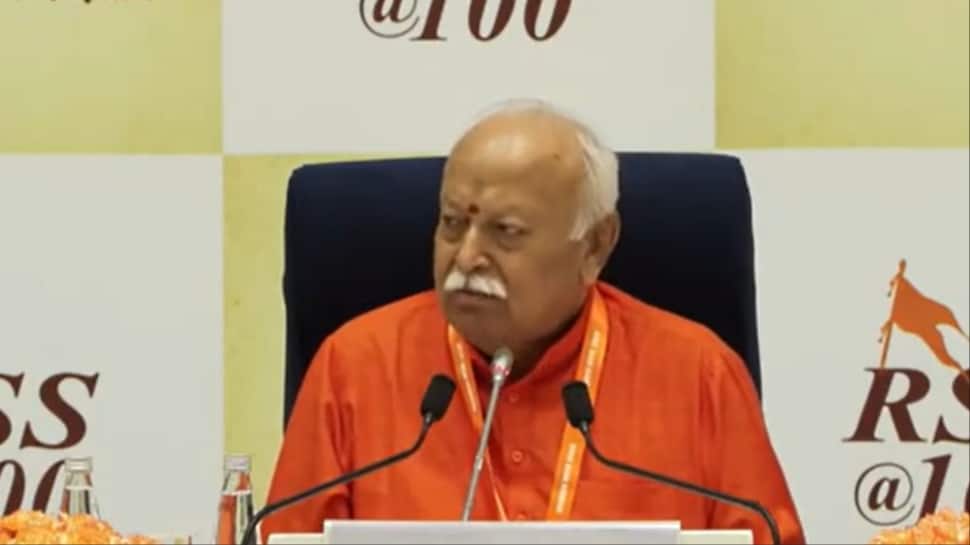
Rashtriya Swayamsevak Sangh (RSS) chief Mohan Bhagwat on Sunday remarked that India is advancing on the path of development by defying global expectations, crediting this progress to the nation’s enduring belief in the traditional trinity of knowledge, action, and devotion.
His comments came in the wake of India’s economy posting a robust 7.8% growth in the April-June quarter of the current fiscal year, the highest in five quarters, preceding the imposition of tariffs by the United States.
Addressing an audience in Indore at the launch of Madhya Pradesh minister Prahlad Singh Patel’s book, Parikrama Kripa Saar, Bhagwat said India was once a global leader for 3,000 years, a period marked by peace, advanced technology, environmental harmony, and a cultured society.
“In that era, we led the world, but did not conquer any country (by attacking) and did not suppress any country’s trade. We did not convert anyone’s religion,” he stated. “Wherever we went, we spread our civilisation and improved the lives of people by imparting knowledge and scriptures. Then all the countries had their own identity, but there was a good dialogue between them. This (dialogue) is not there today,” he added, according to PTI.
The RSS chief attributed the world’s current conflicts to self-interest, arguing it is this that drives strife globally.
He reflected on India’s philosophical roots, emphasising that the forefathers of Indian civilisation demonstrated how to maintain a balanced stream of jnana (knowledge), karma (action), and bhakti (devotion) through various sects and traditions.
“Due to its belief in the traditional philosophy of the balanced trinity of knowledge, action, and devotion, Bharat is continuously moving ahead on the path of development by proving everyone’s predictions wrong,” Bhagwat said.
Citing former British Prime Minister Winston Churchill, he recalled Churchill’s infamous prediction that India would collapse post-independence.
“Winston Churchill once said that after independence (from British rule), you (India) will not be able to survive and will be divided, but this did not happen,” he noted according to the reports, adding, “Now England itself is coming to the stage of division, but we will not be divided. We will move forward. We were once divided, but we will unite again.”
Bhagwat also observed that while the world functions on belief, India is the land of faith, blending logic with action. However, he cautioned that unchecked knowledge and development have also led to destruction, family breakdowns, and a lack of compassion.
“So-called development has taken place, but the environment has also deteriorated, and families have started breaking up. People even abandon their parents on the road (in a neglected state),” he said.
He expressed concern over a perceived erosion of cultural values (“sanskars”) among the younger generation, citing examples of gender identity discourse.
“Due to the lack of sanskars, such a distortion has come in the new generation that there is a demand that if a person born as a boy considers himself a girl, then his assertion should be accepted immediately, and his voice should not be suppressed.”
Highlighting India’s spiritual connection with nature, Bhagwat said reverence for rivers, cows, and trees reflects a conscious, experiential relationship.
“The present world is craving for such a relationship with nature. For the past 300-350 years, countries have been told that everyone is separate and only the strong will survive. They have been told that it does not matter if they trample on someone’s stomach or slit someone’s throat to become powerful.”
He asserted that both knowledge and action are essential, warning against the dangers of passivity and mindless activity.
“Everything goes wrong because of the inactivity of knowledgeable people, and if a person doing an action does not know, then this action becomes the action of mad people.”
Bhagwat also stressed that faith in India is not blind belief but grounded in direct knowledge and experience.
“This feeling of devotion is not for those who firmly believe that the water of Narmada is mere hydrogen oxide. Due to the lack of devotion, foreigners do not call rivers like the Amazon and Mississippi ‘Amazon Maiya’ and ‘Mississippi Maiya’. The tradition of calling rivers the mother is only in India.”
He concluded by asserting that true happiness lies within, not in external excess.
“How many rasgullas can a person eat? Some people can compete and eat up to 100 rasgullas, but a moment comes when even these people vomit after seeing a rasgulla… happiness becomes sorrow when it becomes excessive,” he said.
Invoking Indian philosophy, Bhagwat likened life to a drama, where individuals play their roles before the curtain falls.
“Our ancestors already knew that we are all just a medium in this drama, and the feeling of ‘I and mine’ (personal interest) lasts only till a level, and after that, this feeling has no existence,” he said, adding, “We are all actors in the drama of life and have to play our parts, and our true self emerges when the drama ends.”
He closed with a reaffirmation of Indian culture’s message of unity, transcending personal divisions and ego.