

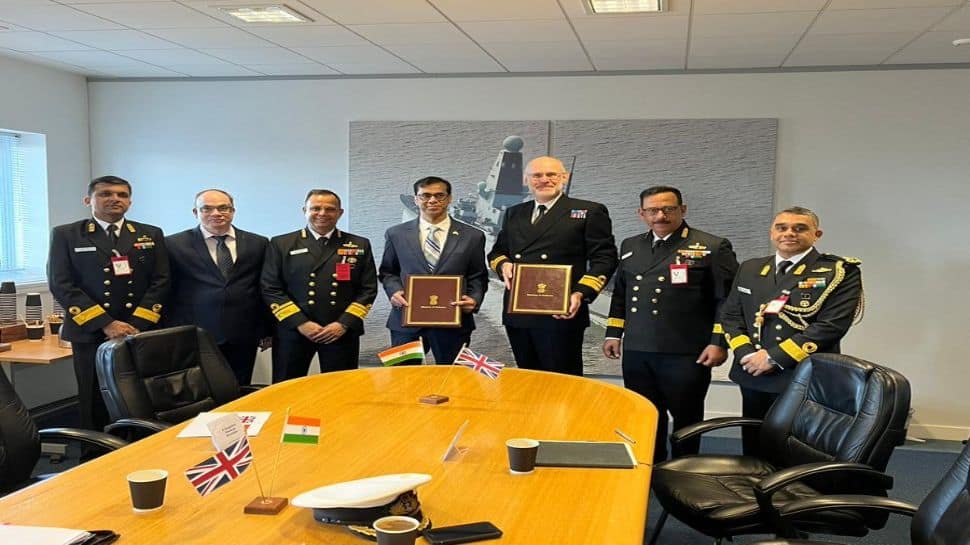
New Delhi: India and the United Kingdom stepped into a long-haul partnership on July 30. A 10-year defence industrial roadmap was unveiled. The plan carries weight. It sets the tone for deeper defence collaboration. It ties into a broader vision. A strategic Vision 2035 between two partners who are leaning closer on security and technology.
The announcement came through an official post. The British High Commission made the announcement on X. The roadmap has clarity – co-development, shared research and innovation in high-end defence systems.
The plan looks at supply chain durability. It focuses on building complex weapons, touches jet and warship engine work and carries implications for both countries’ national security landscapes.
Where the Focus Lies
Technology tops the list. Both nations have locked in programmes. The Electric Propulsion Capability Partnership (EPCP) is one and Jet Engine Advanced Core Technologies (JEACT) is another. These projects go deep. They sit at the core of complex military capabilities.
There is attention on the sea too. A new centre is on the cards. A Regional Maritime Security Centre of Excellence will come up under the Indo-Pacific Oceans’ Initiative. Its goal is capacity-building. The focus will be on countries in the Indian Ocean. It will deal with maritime threats. Not the usual ones. The non-traditional ones. The ones not found on charts or maps.
Defence training will also shift. Joint drills will expand. Land, air and sea will see coordinated exercises. Military instructors will swap places. Training institutions in both countries will see new flags on campus. India will play a new role. It will become a regional logistics hub for U.K. forces.
Research will not stay behind. The joint research and development (R&D) pipeline is opening. Underwater systems are on the agenda. Directed energy weapons are part of the vision. There is an academic angle too. Universities will enter the picture. Labs will turn into innovation clusters for defence.
Cyber matters too. The roadmap includes digital frontlines. It aims to boost cyber resilience. There is also a mention of migration issues. Broader cooperation will take shape here.
Long-Term, Not Quick Fixes
The two nations are not rushing. The vision is paced for a decade. The commitment is steady. Officials on both ends see stability ahead. The plan supports a rules-based global order. It shows intent, not just optics.
It is a layered move. India and the United Kingdom are now looking beyond purchases. They are opening doors to co-creation. Their strengths align. Their ambitions match. The next 10 years are mapped. The jet engines may hum soon. The warships may sail with shared parts. The trust, though, starts now.
We’re deepening collaboration in advanced technologies and complex weapons through programmes like Electric Propulsion Capability Partnership (EPCP) & Jet Engine Advanced Core Technologies (JEACT) Innovation and co-development are key priorities : @UKDefenceIndia pic.twitter.com/geae3R4OUR
— Alpha Defense (@alpha_defense) July 30, 2025
The UK-India defence partnership is set to go bigger. A detailed on what the two countries are setting to work on in the coming decade… pic.twitter.com/NH6CS5jng0
— UK Defence in India (@UKDefenceIndia) July 30, 2025