

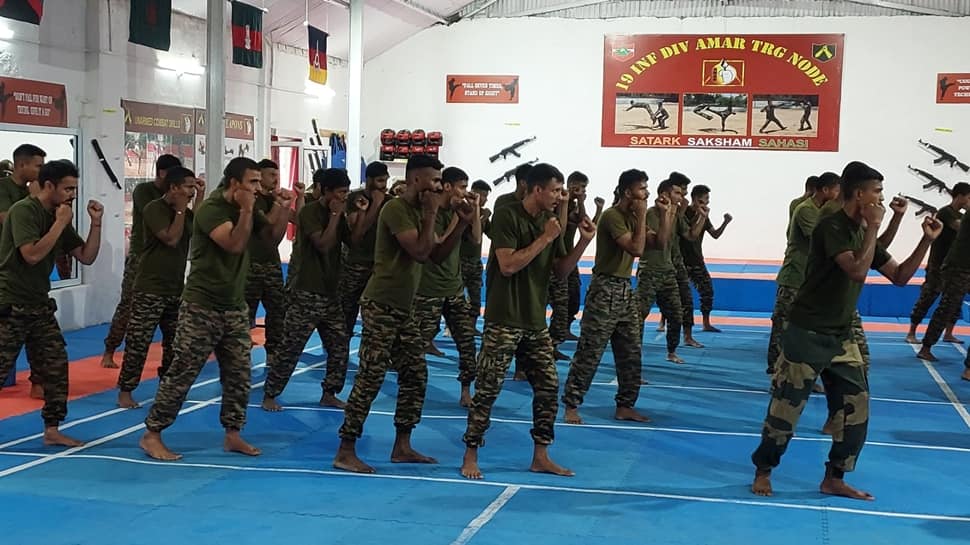
The Indian Army has integrated martial arts into its training regimen, particularly after several incidents at the LoC and LAC where enemies and Indian soldiers had face-offs. One such major incident happened in 2020 in the Galwan Valley with Chinese troops. To enhance soldiers’ hand-to-hand combat skills, physical fitness, and mental resilience, the Indian Army has introduced the “Army Martial Arts Routine” (AMAR), a standardized mixed martial arts program for Indian Army soldiers.
The need for effective unarmed combat skills in situations where firearms are restricted due to bilateral agreements, and soldiers of two countries come face-to-face, such as along the Line of Actual Control (LAC) and at many places on the LoC.
Enemies’ troops were reported to have used improvised weapons like nail-studded rods and spiked clubs, prompting the Indian Army to develop a structured training program to prepare soldiers for such scenarios. During Galwan valley clash with China, the PLA soldiers reportedly used nails-embeded batons/rods. Taking a lesson from the incident, the AMAR program is designed to address these challenges by combining traditional Indian martial arts with modern combat techniques, focusing on offensive and defensive skills against sharp-edged and improvised weapons.
AMAR is a unique, standardized unarmed combat drill aimed at making martial arts a “must-have skill set” for all soldiers. It was developed at the Army Institute of Physical Training (AIPT) in Pune and is now implemented across all field units, mostly in areas near the borders.
The program emphasizes techniques for rapid neutralization of threats; countering sharp-edged and improvised weapons; enhancing strength, reflexes, discipline, and mental toughness; and building small-team coordination and confidence.
This training includes 26 to 64 moves, covering fundamental techniques for rapid assault attacks.
The 28-day course is mandatory in the training of recruiting soldiers, and for those who are already serving, the Army has made this 28-day training course mandatory.
A key facility is the AMAR Node in Kashmir, under the 19th Infantry Division. It trains soldiers from the 15 Corps (Chinar Corps) in a 28-day intensive course, focusing on hybrid combat systems drawn from taekwondo, jiu-jitsu, boxing, and karate. The training is tailored for real-world battlefield scenarios, prioritizing enemy neutralization over sport-style rules.
Similar nodes exist across India, with strategic importance near the Line of Control (LoC) and LAC. All recruits undergo unarmed combat training and receive advanced training in Krav Maga, Silat, Jujutsu, Brazilian Jiu-Jitsu, Muay Thai, and Systema, with a focus on killing with bare hands, live disarmament drills, and pain resistance. This training is critical for operational readiness along volatile borders and reflects a forward-thinking approach to modern warfare.