

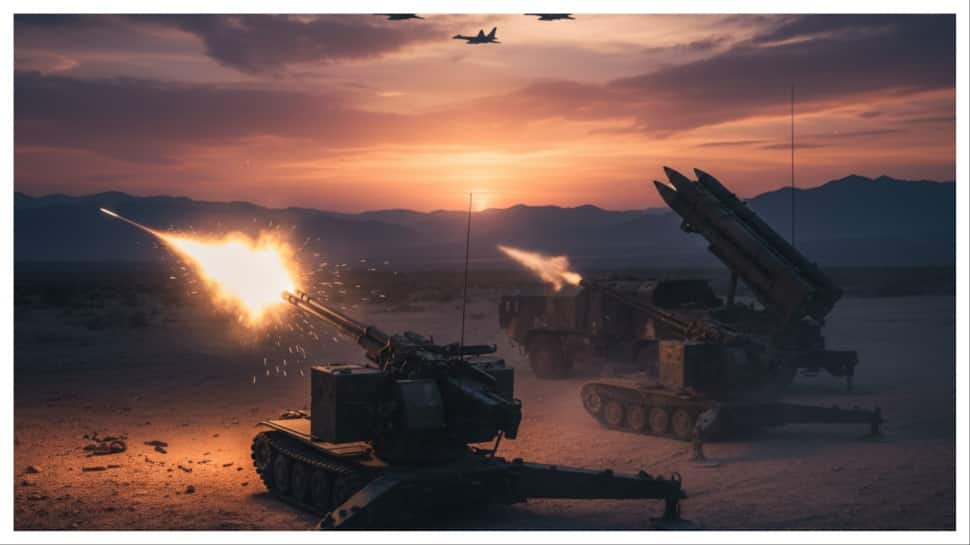
In a major step toward strengthening India’s air defence capabilities, the Indian Army has issued a tender to acquire AK-630 air defence guns from the state-run Advanced Weapon and Equipment India Ltd (AWEIL).
The AK-630 system, a 30mm multi-barrel, mobile air defence gun, will serve as a crucial component in safeguarding key population centres and religious sites located near the India-Pakistan border. Mounted on a trailer and towed by a high-mobility vehicle, the system is designed to intercept unmanned aerial vehicles (UAVs), rockets, artillery shells, and mortars (URAM).
According to defence officials, the gun has an effective range of about 4 km and a cyclic rate of fire of up to 3,000 rounds per minute. Detection and targeting will be managed through an all-weather electro-optical fire control system, enabling accurate engagement of low-flying aerial threats.
Lessons Drawn From Operation Sindoor
The tender has been issued as part of lessons drawn from Operation Sindoor, during which the Pakistan Army carried out attacks targeting civilians and religious structures in Jammu and Kashmir and Punjab. The Indian Army’s air defence units played a decisive role in neutralising aerial threats from Pakistani drones and aircraft during the operation.
Mission Sudarshan Chakra
The procurement falls under Mission Sudarshan Chakra, a key national security initiative unveiled by Prime Minister Narendra Modi during his Independence Day address, aimed at modernising India’s defence infrastructure and enhancing operational readiness.
Mission Sudarshan Chakra envisions creating a multi-layered, indigenous national security shield by 2035, integrating advanced surveillance, cybersecurity, and air defence systems. The mission also aligns with the government’s Aatmanirbhar Bharat initiative, promoting self-reliance in defence technology and manufacturing.
Pahalgam Terror Attack To Operation Sindoor
Operation Sindoor, launched on May 7, was India’s response to the April 22 Pahalgam terror attack that claimed 26 lives. The operation involved precision strikes on nine terrorist camps across Pakistan and Pakistan-occupied Kashmir, inflicting heavy damage on infrastructure used by groups such as Jaish-e-Mohammed and Lashkar-e-Taiba. Reports suggested that over 100 militants were killed in the offensive.
(With ANI Inputs)
ALSO READ: Who Is Sanae Takaichi? Japan’s First Female Prime Minister-In-Waiting