

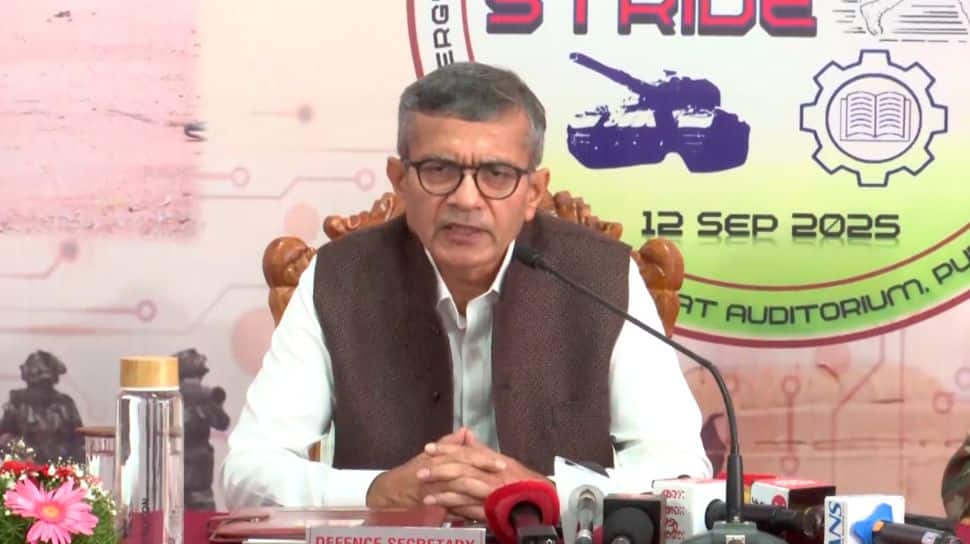
Defence Secretary Rajesh Kumar Singh on Friday said that Operation Sindoor was a “reality check” for the Indian Armed Forces, highlighting areas where improvements are needed and where adaptations must be made to meet the changing demands of future warfare.
Operation Sindoor Exposed Key Capability Gaps
Speaking at the Southern Command Defence Tech Seminar (STRIDE 2025), Defence Secretary Singh said the operation exposed key capability gaps in electronic warfare, counter-drone systems, low-level radars, and the need for a stronger ecosystem for military-grade drones capable of operating in GPS-denied or contested environments.
“It’s pretty clear in the context of the geopolitical situation now that most countries are paying a lot of attention to defence and hard power again. Given our neighbourhood, India is no exception, and we’ve just had this experience with Operation Sindoor, which was in some ways a reality check for us in terms of where we can do better, where we need to adapt to changing needs for future warfare,” Defence Secretary said during a press conference in Pune.
Defence Secretary Singh said, “So in the context of Operation Sindoor, I think that certain capability gaps were noticed, and those include areas like electronic warfare, counter-unmanned systems, better manufacturing ecosystem for military-grade drones, which can survive better in GPS-denied and other contested environments. Various types of low-level radars as well. So yeah, we had some areas where we thought that we needed to beef up our capabilities.”
Air Defence
Emphasising the critical importance of air defence, Defence Secretary Singh said India, being a large landmass, must ensure that its critical infrastructure, population centres, and industries are protected. He added that, in the future, the country will need to upgrade existing systems where possible and acquire new equipment where necessary.
“Air defence is very critical and which is why PM, from Red Fort, announced a new mission ‘Sudarshan Chakra’ which will have some elements of defence and some elements of offence. We already have a fairly strong multi-layered air defence system which worked very well during Operation Sindoor period. I don’t think we suffered any major losses or casualties despite repeated attempts through drones and missiles to penetrate that system. But India is a large landmass and we need to ensure that our critical infrastructure and population centres and industry get cover. That is an ongoing work…But for the future we will have to upgrade where we can and buy new equipment where we need to. That process will be given adequate attention during the preparation of this ‘Sudarshan Chakra’ mission for which the DRDO has been tasked with preparing a DPR to meet any gap in our air defence system,” he said.
Operation Sindoor
Operation Sindoor, initiated on May 7 in retaliation for the Pahalgam terror attack—where 26 innocent civilians were gunned down by Pakistan-sponsored terrorists—saw the Indian Armed Forces launch precision strikes on Pakistan and Pakistan-occupied Kashmir. In these strikes, several terror infrastructures were destroyed and over 100 dreaded terrorists were killed.
ALSO READ: Will Nepal’s Political Turmoil Derail India’s Multi-Billion Dollar Projects?