

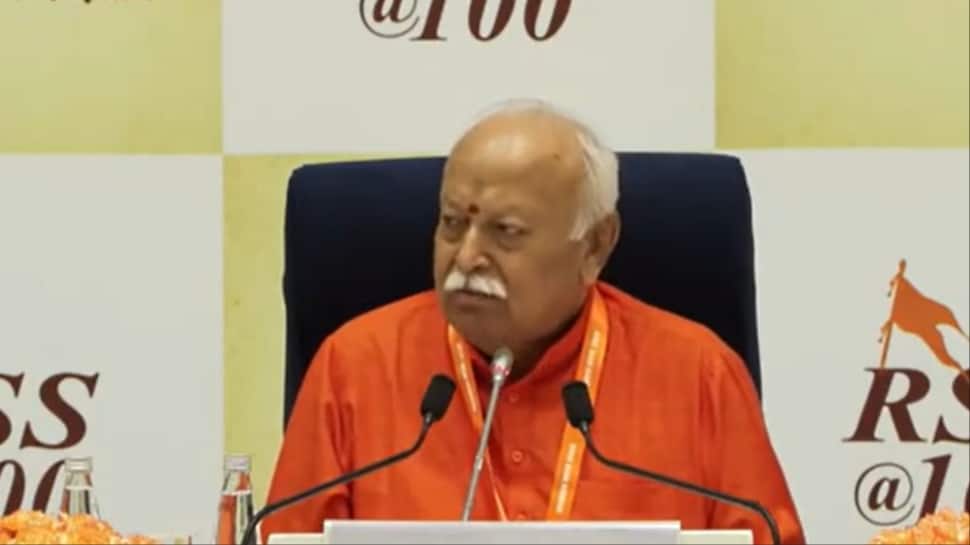
Rashtriya Swayamsevak Sangh (RSS) chief Mohan Bhagwat on Thursday called for a renewed push towards self-reliance and indigenous production, responding to recent US trade measures that have sparked debate over India’s economic strategy and foreign relations.
Speaking at the centenary celebrations of the RSS, Bhagwat addressed the growing global interdependence and emphasised that India must focus on swadeshi, a call that aligns with Prime Minister Narendra Modi’s own push for promoting locally-made goods.
“The new tariff policy implemented by the US was done keeping in mind their own interest. But everyone is affected by such decisions,” said Bhagwat, adding, “The world functions through mutual dependence. This is how relations between nations are maintained. No country can survive in isolation. However, this dependence must not become a compulsion. We must focus on swadeshi and self-reliance, while continuing diplomatic ties with friendly nations on our terms, not under pressure,” he added.
His comments come in the wake of escalating trade tensions, including the 50% tariff hike on Indian goods imposed by the United States in August, and former President Donald Trump’s move to raise the H-1B visa fee to USD 100,000 (₹88 lakh), further straining bilateral trade relations.
Modi’s Echo Of Swadeshi
Prime Minister Narendra Modi has recently echoed similar sentiments. In a televised address, he urged the nation to embrace indigenous products and take pride in buying Indian-made goods.
“Say it with pride, I buy swadeshi,” Modi said, adding that people often remain unaware of whether basic items like combs are made domestically or imported.
“We should buy products that are Made in India, crafted through the hard work of our country’s youth, products that carry the sweat of our sons and daughters,” he added.
The Prime Minister’s remarks reflect a growing call for economic self-sufficiency amid rising protectionism and trade disputes worldwide.
A Wide-Ranging Address By Bhagwat
Bhagwat’s address during the centenary function also touched on issues beyond trade and diplomacy. He commented on the recent terrorist attack in which 26 Indians were killed after being asked their religion.
“The nation was mourning and angry about the terror attack. With complete preparations, our government and armed forces gave a befitting reply. The government’s dedication, the armed forces’ valour, and the unity in society created an ideal atmosphere in the country,” he said.
Bhagwat highlighted how the international response to the incident revealed India’s true allies and warned of internal threats as well.
“Within the country too, there are unconstitutional elements who try to destabilise the nation,” he cautioned.
On Civil Unrest And Protest
Addressing the issue of public dissatisfaction and civil unrest, the RSS chief warned against turning grievances into violent action.
“When the government becomes distant from the people and fails to address their concerns, public resentment grows. But resorting to violent methods to express discontent benefits no one,” Bhagwat remarked.
“If we study the history of political revolutions, none have achieved their intended aims. Instead, many of these nations have merely transformed into capitalist states. Such unrest often becomes a tool for external forces to meddle in internal affairs,” he warned.
Concerns Over Himalayas
Bhagwat also raised environmental concerns, particularly about the changing climate in the Himalayan region.
“Natural calamities have increased. Landslides and incessant rainfall have become routine over the last 3-4 years. The Himalayas are our security wall and the source of water for South Asia. If current development models are worsening this situation, we must reconsider our choices,” he said.
India’s Global Role
Closing his address, Bhagwat said the world is increasingly looking to India for leadership in solving global problems.
“The universe wants India to lead by example and show the world a way,” he noted, underlining the belief that India must rise not just economically, but morally and culturally, to fulfil its role on the global stage.