

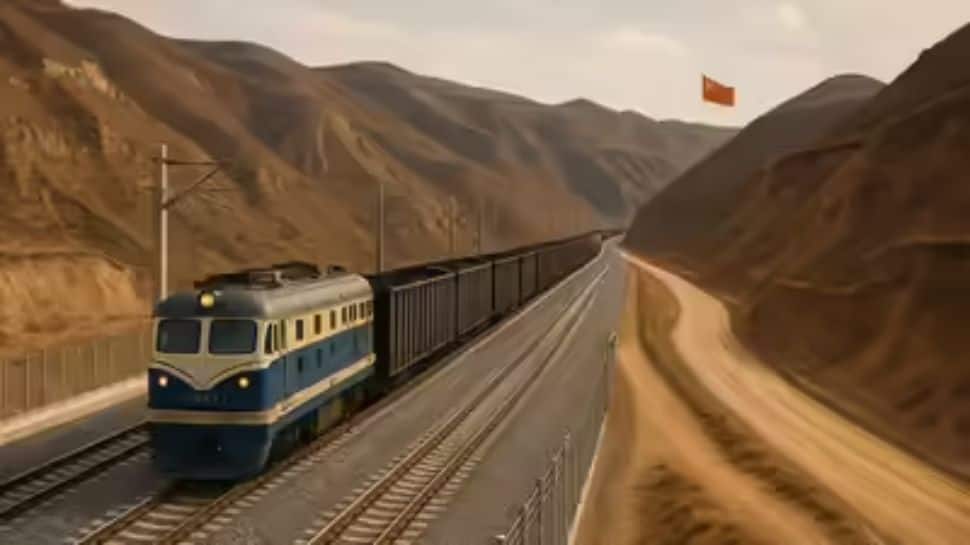
New Delhi: A fresh warning has reached New Delhi. Tibetan experts have raised a red flag over China’s latest activity along the Line of Actual Control (LAC). Beijing has launched a new railway project that cuts across the western sector near Ladakh, an area known for its fragile calm and deep military tension.
This is not China’s first push along the border. For years, it has been busy building roads and bunkers near Arunachal Pradesh. But this new line in western Tibet, experts say, is something else, a strategic build that could alter the region’s balance.
China claims the project is part of its plan to connect Tibet’s capital Lhasa to central routes. The real story, analysts say, lies in what this line can carry: soldiers, tanks and war logistics.
China has now set its focus on a vast railway stretch cutting through central Tibet. Officially described as an effort to “improve connectivity”, the construction is seen as a military enabler. Reports suggest that the network will strengthen troop movement and supply routes near India’s borders.
According to ANI, China’s speed is astonishing. Experts believe it can finish this difficult Himalayan line in just five years. By the next decade, Beijing plans to have 5,000 kilometres of rail weaving through the Tibetan plateau.
Operation Sindoor And China’s New Game
Tsewang Dorjee, a research scholar at the Tibet Policy Institute, has connected this new push to post-Operation Sindoor tensions. “China’s new railway and highway projects near India’s borders are directly tied to its ongoing security operations,” he said.
In the eastern sector, near Arunachal Pradesh, he added, China already controls major water resources to use against South Asian countries. Now, in the western sector, near Ladakh, Himachal and Uttarakhand, it is laying new railway lines. “After Operation Sindoor, China has become extremely alert,” he highlighted.
Roads, Rails And Resources
Dorjee pointed out that Beijing is also building a highway between Nagchu and Ngari. Every piece of this network, he said, has one goal: to make movement easier for the People’s Liberation Army (PLA).
“If tensions flare into conflict, these infrastructure projects will give China an upper hand,” he warned.
Beyond military use, the line could serve another purpose, which is tapping into Tibet’s hidden wealth. The region holds large deposits of uranium and lithium, both essential to China’s booming AI and tech industries.
The Line That Nears Ladakh
The new line will run through western Tibet, passing near Mount Kailash and Ngari and extend up to Shigatse in central Tibet before connecting to Aksai Chin and East Turkestan.
Tibetan writer and activist Tenzin Tsundue warned, “The route passes just 20 to 30 kilometres from Demchok in Ladakh. Construction is happening at wartime speed. The project could be ready in five years.”
He highlighted that while India’s own railway projects in the Himalayas are still in planning, Beijing’s lines are moving rapidly across terrain parallel to the Indian frontier.
The Hidden Agenda
According to Tsundue, western Tibet holds vast reserves of gold, copper, zinc and lithium, resources that China wants to mine under the cover of “development”. “This project is about mining and military dominance. It reflects China’s expansionist mindset and its intent to control the Indian Himalayan region,” he said.
Both experts agree on one thing: this is no routine project. It is a deliberate, large-scale move with deep military, economic and geopolitical impact. From Lhasa to Ladakh, the steel tracks of China’s Himalayan rail are not merely lines on a map. They are the signs of a rising power carving its path toward India’s gates.