

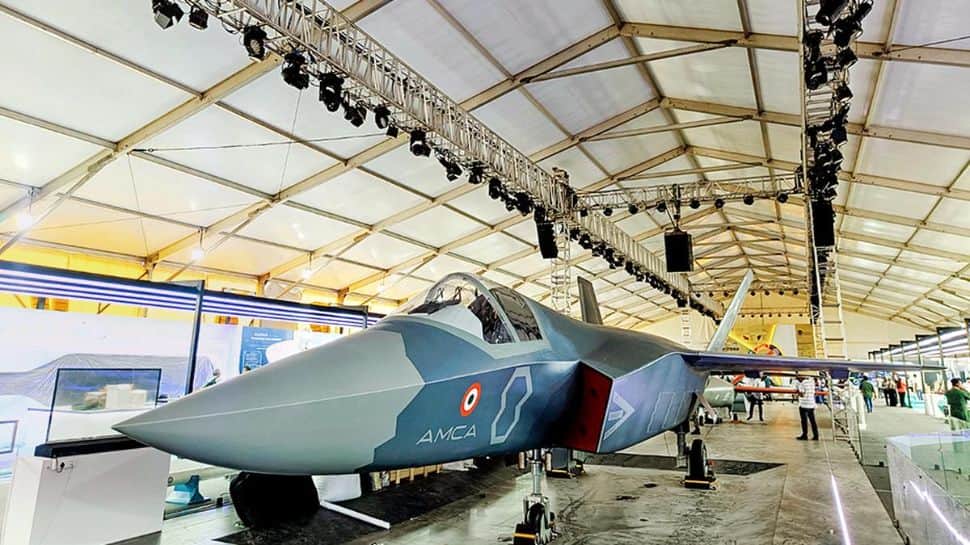
New Delhi: India’s skies are about to change. Not today, maybe not this year, but the Indian Air Force (IAF) is already preparing for what is coming next. It will mark a new era and a new generation of fighter jets. The clock is ticking.
India is working on its own fifth-generation fighter jet project. The Advanced Medium Combat Aircraft (AMCA) has already moved past the blueprint stage. Engineers are building and scientists are testing. But the finish line is still years away.
That is why New Delhi is now weighing options beyond its borders.
No fighter jet defines power like a fifth-gen stealth aircraft. China already flies the J-20. The United States has its F-35. Russia flies the Su-57. But India, which is a nuclear-armed regional power, has none in active service so far.
The IAF knows the gap is growing. It knows the future belongs to low-observable jets that can fly deep into enemy airspace and return unseen. Stealth is no longer a luxury, it is a necessity.
So, where does India go next?
India’s Jet of the Future Still in the Making
The AMCA is a homegrown dream. It stands for autonomy and reflects capability. But the aircraft is not going to take to the skies before the end of this decade. That is the reality.
This timeline has opened space for new discussions. Foreign platforms are being evaluated. India is not rushing. It is watching, listening and calculating.
Among the contenders, two names often come up – the Russian Su-57 and the American F-35. Both are stealth fighters, which promise air superiority. But both come with complex political baggage.
The government has not made its choice. Experts, too, remain cautious. No official confirmation exists about which jet, if any, India is truly leaning toward.
F-35 Still a Name on Paper
There were murmurs and headlines. Some even claimed India had shown interest in the F-35. But Minister of State for External Affairs Kirti Vardhan Singh set the record straight in Parliament.
He said there have been no formal talks between India and the United States on the F-35. He referred to a joint statement made in February 2025, after Prime Minister Narendra Modi’s meeting with US President Donald Trump. In that statement, Washington said it would review its fifth-gen fighter export policy to India. But that was it. There were no follow-ups, no negotiations and no detailed proposals.
For now, the F-35 remains outside India’s hangars.
Experts Flag Integration Issues
Defense expert Dinakar Peri said India cannot ignore the fifth-gen void for long. The IAF needs it. But even a small batch of jets would come with cost, infrastructure changes and long-term support requirements.
He said India’s own AMCA project is making steady progress. It may take up to 10 more years, but it will be India’s own. If New Delhi buys foreign jets in the meantime, the risks are resources, manpower and focus may shift away from the AMCA.
A senior fighter pilot from the IAF, speaking on the condition of anonymity, said picking a jet is not only about its top speed or radar profile, It is about compatibility. Can it work with our current systems? Can it talk to our radar? Will it fit our airbases and logistics chains?
He raised a flag about the F-35. It is embedded in America’s digital warfighting ecosystem. Plugging it into India’s mixed inventory, which is Russian, French and Israeli, will not be seamless.
F-35 Might Be Overkill
Peri also made another point. The F-35 may be the best fighter jet in the world, but the best is not always the best fit.
India does not have the digital infrastructure that supports the F-35. Building that framework would take time, effort and billions.
He also questioned how much the United States would allow India to modify or customise the jet.
India uses Su-30MKI fighters. It operates the S-400 missile system. Its radars and guidance systems come from multiple countries. If the F-35 cannot “speak” to these systems, its stealth and combat edge could be wasted.
Could Su-57 Fill the Gap?
If the F-35 feels too distant, some believe the Su-57 might be closer. Russia and India share decades of military cooperation. Many Indian pilots already fly Russian aircraft. The Su-57 would not be a cultural shock.
But nothing is simple. Western sanctions on Moscow are real. Supply lines are not stable. Payments could get stuck. Production delays have happened before. Technical concerns have also surfaced. Trusting the Su-57 would still be a gamble.
That said, the Su-57 does offer one potential advantage that Russia may be willing to share more technology than the United States would. The jet could integrate better with India’s Russian-made airframes. Maintenance, too, may be easier.
But even this path remains full of “ifs”.
The Sky Is Watching
India has time but not forever. The AMCA is coming. But the wait is long. China is moving fast and Pakistan is watching closely. The geopolitical chessboard is shifting.
The IAF has always flown a mixed fleet. It has managed French, Russian and indigenous jets with discipline and skill. But fifth-gen warfare will test every system, every radar and every pilot.
The decision India makes in the coming months could define its air dominance for the next two decades. Will it fly stealth with America, partner deeper with Russia or wait for its own jet to rise?
No one knows. But the sky will not wait forever.