

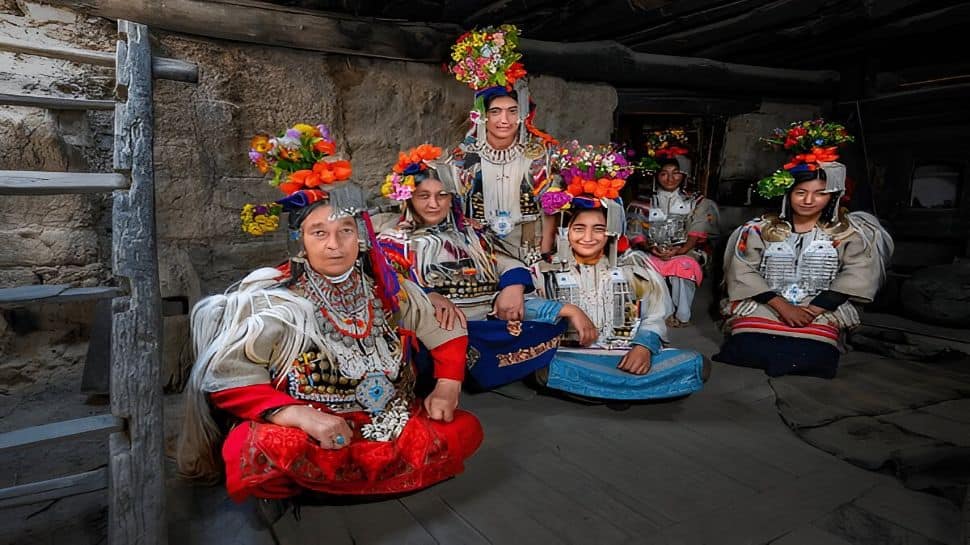
Leh: When most people hear ‘pregnancy tourism’, images of expectant mothers travelling to foreign lands for citizenship or healthcare come to mind. Couples plan carefully, chasing better futures, access to education or social benefits for their unborn children.
But in Ladakh’s Aryan Valley, the idea flips completely. Here, it has little to do with bureaucracy or hospitals. Instead, it is wrapped in stories of ancient legends, old folklore and an unusual obsession with the idea of “pure Aryan” bloodlines.
The ‘Last Aryan’ Legend
Nestled in villages like Dah, Hanu, Darchik, Biama and Garkon, the Brokpa community people, who are also called Drogpa or Drokpa, claim to be direct descendants of Aryans. They stand out from other Ladakhi communities with their tall frames, fair skin and light-colored eyes.
Over the years, tourism narratives and local lore have labelled them as the “last pure Aryans”, tracing their ancestry back to soldiers who marched with Alexander the Great.
Whether the story is true or not is another matter. But it has given rise to an even stranger claim.
The Pregnancy Tourism
Some reports suggest that women, mainly from Germany and other European countries, travel to Brokpa villages with one goal: to conceive children with Brokpa men. The belief is that their babies would inherit “pure Aryan” traits.
In certain accounts, local men are said to receive financial compensation, turning conception into a commercial transaction.
Myth Meets Reality
Scientific scrutiny tells a different story. Geneticists and historians widely dismiss the notion that Brokpas are pure Aryan descendants. No verified evidence supports it.
Similarly, pregnancy tourism in the valley appears to be isolated, not organised. Most stories come from whispers in guesthouses, exaggerated travel blogs or word-of-mouth.
Journalists and anthropologists who have spent time there observe that while some cases may exist, it is far from a widespread practice.
Travel vlogger Soumil Agarwal too ventured into the Aryan Valley to hear the truth directly from the villagers. His interviews reflected the same uncertainty. Some residents confirmed that foreign women had visited for “Aryan babies”, while others completely rejected the idea. Even the village head (name withheld) called the stories “complete hearsay”.
Observers also point out that the phenomenon may have been exaggerated by locals themselves, adding a layer of intrigue and drawing more visitors to the villages.
Between Folklore And Gossip
Ladakh’s so-called pregnancy tourism sits between folklore and gossip. It survives not because of facts, but because of fascination. The true allure of the Aryan Valley may not lie in babies born of legendary genes but in the stories themselves: persistent, captivating and impossible to ignore.