

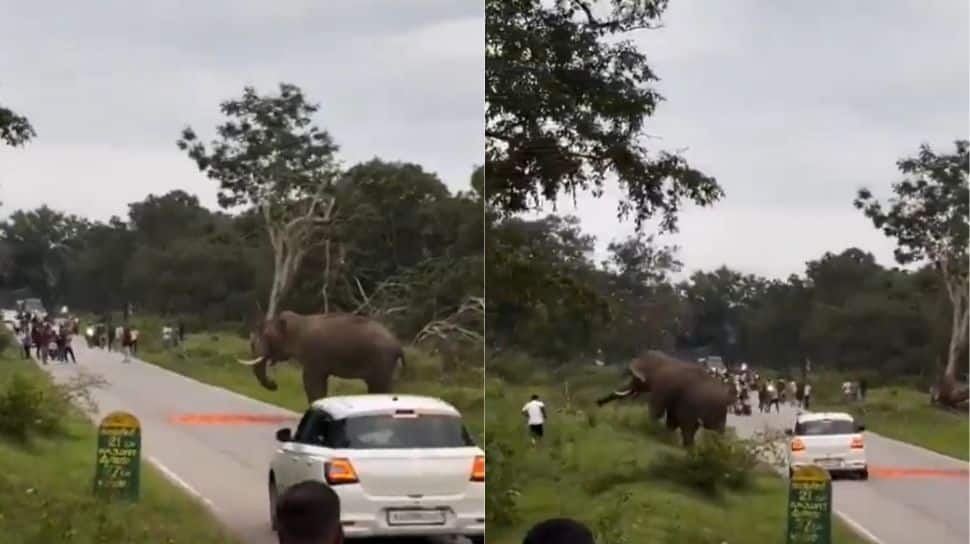
Karnataka, India — What began as a tourist’s attempt at a daring wildlife selfie ended in chaos, injury, and public outrage.
On Sunday, Forty-year-old R. Basavaraju entered a restricted forest area near a temple in Karnataka, where he encountered a wild elephant feeding by the roadside.
Ignoring safety rules, Basavaraju approached the animal with his phone in hand.
Witnesses say the situation took a dangerous turn when his camera flash startled the elephant. “It immediately became agitated,” recalled Daniel Osorio, a bystander who filmed the scene.
The footage, now viral online, shows the elephant raising its trunk and charging across the road, scattering vehicles and pedestrians. As Basavaraju fled, he tripped and fell face-first onto the tarmac.
Risking your life for just selfies is foolishness.
A Kerala tourist miraculously survived after a elephant attacked him in Bandipura Tiger Reserve. pic.twitter.com/6jGY78btn6
— Team Jhaat Official (@TeamJhaant__) August 11, 2025
Within seconds, the elephant caught up, trampling him repeatedly. The attack was so forceful it ripped away his trousers and underwear, leaving him exposed as horrified onlookers shouted in panic.
After a tense moment, the elephant stepped back and eventually retreated into the forest, giving the injured tourist a chance to escape. Basavaraju was rushed to hospital with serious injuries but is expected to recover.
The Forest Department fined him ₹25,000 for trespassing and provoking wildlife. He was also required to record a video confession, admitting his ignorance of wildlife safety rules.
“This incident is a strong reminder to follow the rules of wildlife reserves and let trained authorities handle such situations,” Osorio said.
Calls to Criminalise Wildlife Provocation
India is home to over 30,000 wild elephants more than any other country and accounts for 60% of the global Asian elephant population. While elephants are generally gentle, conservationists warn that provocation or fear can trigger dangerous aggression, particularly in areas where tourism blurs the lines between human and animal spaces.