

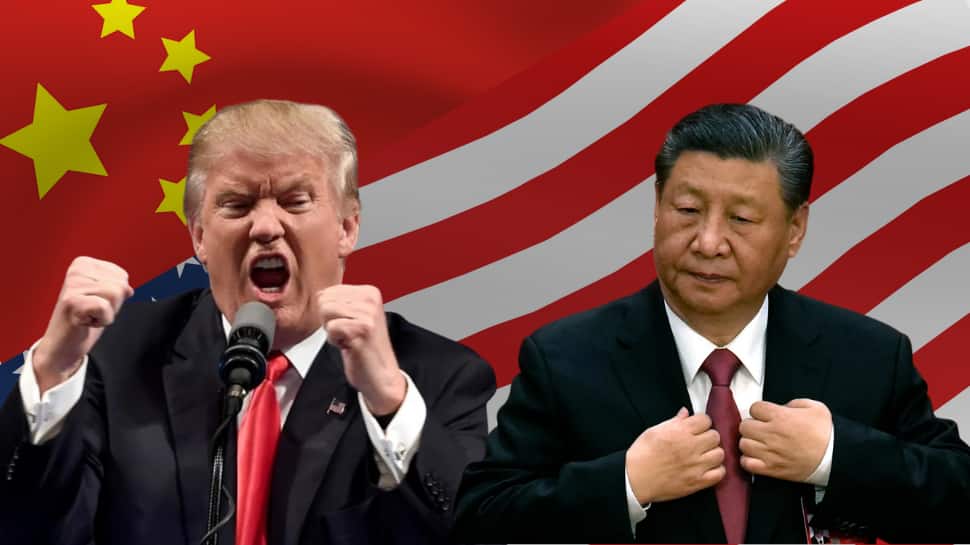
US President Donald Trump on Friday announced a 100 percent tariff on all Chinese goods, in addition to existing duties, effective November 1. He also unveiled new export restrictions on “all critical software,” marking one of the most aggressive trade measures against China.
“Starting November 1, 2025, the United States of America will impose a Tariff of 100% on China, over and above any Tariff that they are currently paying,” Trump said on Truth Social, adding that Washington will also impose export controls on “all critical software and aircraft parts.
China fired the first shot. Earlier this week, Beijing declared unprecedented export restrictions on rare earth elements, the critical minerals that power everything from your iPhone to F-35 fighter jets. China controls the maximum of global rare earth processing.
China expanded its restricted rare earths list from 7 to 12 elements, adding holmium, erbium, thulium, europium, and ytterbium, and extended controls to cover not just the materials themselves but the entire production chain: mining technologies, smelting processes, and magnet manufacturing.
What are rare earths, and why does it matter
Rare earth metals, or rare earth elements (REEs), are a group of 17 chemical elements on the periodic table that share similar chemical properties and are silver-coloured in appearance.
Rare earth elements are the invisible backbone of modern technology, powering a wide range of applications. In the military sector, they are essential for precision-guided missiles, jet engines, radar systems, and night-vision goggles. In consumer electronics, they are used in smartphones, laptops, flat-screen TVs, and headphones. They also play a vital role in clean energy technologies such as wind turbines, electric vehicle motors, and solar panels, as well as in industrial applications including medical imaging equipment, lasers, and fiber optics.
But why are Chinese curbs on rare earth exports significant?
Since the 1990s, China has maintained an unchallenged dominance in the rare earth sector, meeting 85–95 percent of global demand. According to The Financial Times reports, China currently controls around 70 per cent of rare earth mining, 90 per cent of the separation and processing capacity, and 93 per cent of global magnet manufacturing.
Beijing declared rare earth elements a “protected and strategic mineral” in the 1990s, giving itself powerful leverage in global trade. Over the years, China has used this dominance as a strategic tool, notably restricting exports to Japan in 2010 during a fishing trawler dispute, and again targeting the United States between 2023 and 2025 amid rising trade tensions.
Could Trump’s new countermeasures ignite another trade war with China?
To recall, after returning to the White House in January, Trump repeatedly targeted China with a series of steep trade measures. He first imposed a 10% tariff on fentanyl imports and later raised it to 20%, followed by a sweeping 145% tariff on all Chinese goods entering the United States in April.
China hit back with 125% retaliatory tariffs and tightened controls on rare earth exports through a complex licensing system, citing national security reasons. It also introduced new taxes on US coal and liquefied natural gas (LNG) exports, further intensifying the ongoing trade confrontation between the two countries.