

New Delhi: Voting is underway today for the election of India’s 15th vice president. The results will also be declared before the day ends. The Vice President of India is not elected on the basis of party symbols. For this reason, political parties do not issue a whip to their members. Every MP eligible to vote can support any candidate in the fray.
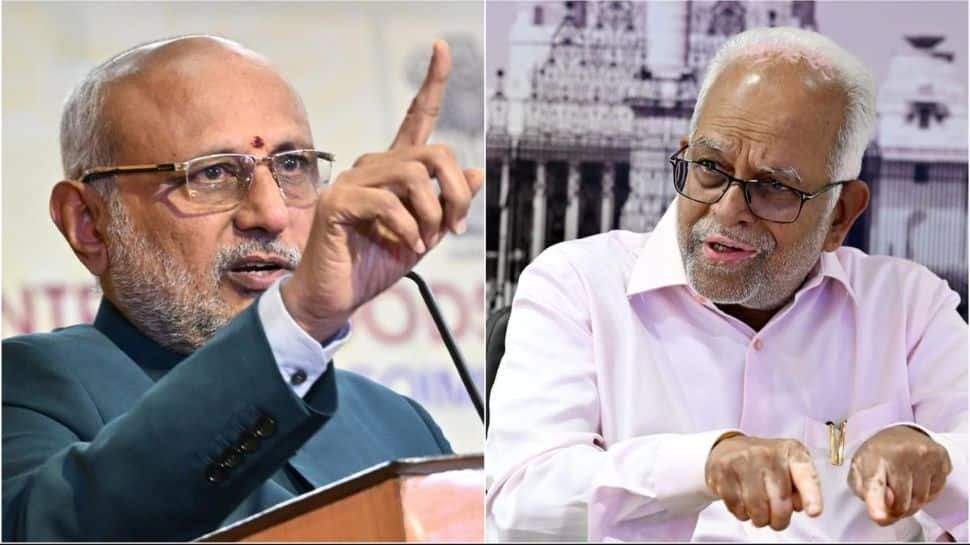
This year, the Bharatiya Janata Party (BJP)-led National Democratic Alliance (NDA) has fielded C.P. Radhakrishnan, a senior party leader from Tamil Nadu who has also served as the state president of the BJP.
The Opposition INDIA bloc has nominated Justice B. Sudershan Reddy, former Supreme Court judge, who hails from Andhra Pradesh.
With both candidates belonging to southern states, the contest has drawn attention to the region’s political weight.
Govt Faces A New Test
The last vice presidential election was held in August 2022. In that poll, NDA’s Jagdeep Dhankhar secured a resounding victory with 528 votes out of 725, a winning margin of nearly 73%.
However, he resigned from the post in July this year, triggering today’s election.
Reports of cross-voting have added drama to the contest. The NDA has the numbers to secure a win, but any reduction in the margin could allow the Opposition to argue that the ruling side is not as dominant as it once was.
Speculation continues over Dhankhar’s sudden resignation. There are still questions on why Dhankhar stepped down. The government is already facing pressure on certain foreign policy issues, and this is why people say cross-voting may take place.
Going by the recent elections at the Constitution Club of India, where BJP MP Rajiv Pratap Rudy defeated former BJP MP Sanjeev Balyan, who reportedly had the backing of Union Home Minister Amit Shah. It was a small election, but the high command’s candidate lost. That has raised doubts. Some believe BJP members themselves could cross-vote. This is why Prime Minister Modi has to prove that his control remains firm.
Why The Vice President Matters
The vice president is the ex-officio chairman of the Rajya Sabha. The role often appears ceremonial, still it carries constitutional weight.
The vice president ranks second in protocol after the president. In the absence of the president, it is the vice president who discharges his/her functions. So even if no direct work is visible, the position holds prestige and influence.
The political context makes this election significant. The BJP and Prime Minister Modi will want to secure a large margin. It is about showing strength. The election itself may not change much, but the scale of victory matters.
This year’s election involves 782 total votes. The NDA commands 422 votes, which is 31 more than the required majority of 391. The INDIA bloc holds 312 votes.
Opposition’s Challenge
Every ruling party wants its own people in positions such as the president, vice president or speaker.
The Congress also wanted the same when it held power. The Opposition failed to reach consensus, and that has weakened its hand. If the Congress thinks it can split ruling party votes, it will not succeed. In fact, some Opposition votes may go to the NDA candidate.
For the Congress and its allies, the task is steep. After the 2024 general election, the NDA returned to power with a comfortable majority, and the coalition arithmetic has not changed much since then.
There have been headlines around allies such as the Telugu Desam Party (TDP), which expressed displeasure over issues such as the Special Intensive Revision (SIR) being conducted by the Election Commission in poll-bound Bihar.
But analysts believe this will not translate into a break with the NDA. Politics runs on goals, not emotions. TDP chief and Andhra Pradesh Chief Minister Chandrababu Naidu has supported the government on the Goods and Services Tax (GST), language issues and the Waqf Amendment Bill. There is nothing to suggest he will walk away.
Analysts dismissed parallels with 1999, when the then Atal Bihari Vajpayee’s government fell by a single vote after Bahujan Samaj Party (BSP) chief Mayawati withdrew support. That is not the situation today. The government’s stability is not under threat. Only if 100 votes were to shift from the ruling side to the Opposition would the picture change, and that is unlikely.
Smaller Players In Spotlight
The Biju Janata Dal (BJD) has chosen to stay neutral and will not vote for either candidate. Several other regional parties may not change the outcome, but they could influence the final margin. In Indian politics, even the size of a victory carries meaning.
As voting continues, the NDA’s candidate looks set for a win. The Opposition remains hopeful of symbolic gains, banking on cross-voting and shifts in loyalty to reduce the ruling bloc’s margin. By tonight, India will know who will occupy the country’s second-highest constitutional office.