

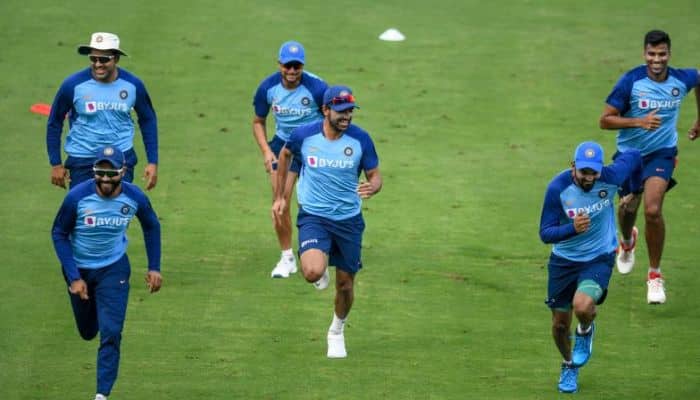
In a significant shift aimed at elevating player fitness, the Indian cricket team has introduced the rugby-centric Bronco Test at the BCCI’s Centre of Excellence in Bengaluru. This new regimen is designed to improve aerobic capacity, endurance, and overall match readiness, particularly for fast bowlers, who will now focus more on running than solely gym-based workouts.
Also Read: Asia Cup 2025: All You Need To Know About Live Streaming, Squads, Fixtures & Dates
What Is the Bronco Test?
The Bronco Test is a rigorous shuttle run exercise adapted from rugby training, involving multiple sprints of 20 metres, 40 metres, and 60 metres. One set of the test comprises these three runs, and players are required to complete five sets consecutively, covering a total distance of 1,200 metres. The benchmark set for Indian cricketers is six minutes, demanding a combination of speed, stamina, and mental toughness.
This test complements existing fitness standards such as the Yo-Yo Test and the 2-kilometre time trial, which are already part of the BCCI’s fitness protocols. While the Yo-Yo Test measures intermittent recovery and endurance levels, the Bronco Test emphasizes continuous aerobic capacity and explosive speed—crucial attributes for fast bowlers and all-rounders alike.
Adrian le Roux’s Fitness Vision
The move comes at the recommendation of Adrian le Roux, the Indian team’s newly appointed strength and conditioning coach. Having previously served in the same role for the Indian team from 2002 to 2003, as well as stints with Cricket South Africa and IPL franchises like Kolkata Knight Riders and Punjab Kings, Le Roux brings a wealth of experience in modern sports science.
Le Roux has highlighted the need for fast bowlers to increase running mileage instead of focusing predominantly on weight training. “Indian cricketers, especially pacers, were not running enough and were spending too much time in the gym,” a source close to the team explained. Head coach Gautam Gambhir has also endorsed this approach, emphasizing that a fitter, more agile bowling unit will be vital for upcoming international tours.
Learning from the England Series
The impetus for this fitness overhaul came after India’s five-Test series in England, where the stamina levels of a few fast bowlers were found lacking. Only pacer Mohammed Siraj featured in all five Tests, highlighting the need for enhanced endurance and resilience among the pace attack. By implementing the Bronco Test, the team aims to ensure that fitness shortcomings are addressed well ahead of critical fixtures.
Integration with Existing Fitness Protocols
Alongside the Bronco Test, Indian cricketers continue to undergo the Yo-Yo Test and the 2-kilometre time trial. For context:
2-Km Time Trial: Fast bowlers must complete it in 8 minutes 15 seconds, while batsmen, wicket-keepers, and spinners have a benchmark of 8 minutes 30 seconds.
Yo-Yo Test: Involves running between markers 20 metres apart at increasing speeds, with a 10-second break after every 40-metre run. The minimum Yo-Yo level for Indian players is 17.1.
The Bronco Test adds an extra dimension to these standards, combining short-distance sprints with endurance to replicate match-specific conditions. Several top Indian players have already taken the test at the Bengaluru facility, marking the start of a more fitness-focused era.
A Strategic Move for Peak Performance
By integrating the rugby-inspired Bronco Test, the Indian cricket team is signaling its commitment to cutting-edge training methods. The emphasis on running, endurance, and functional fitness aligns with global best practices in cricket conditioning, ensuring players are prepared for the increasing physical demands of modern international cricket.
As India gears up for upcoming tours and tournaments, this fitness-centric approach, championed by Adrian le Roux and supported by Gautam Gambhir, could be the difference between sustaining a competitive edge and falling short in high-intensity encounters. The Bronco Test may well become a benchmark for measuring the team’s future readiness, setting a new standard for Indian cricket fitness.