

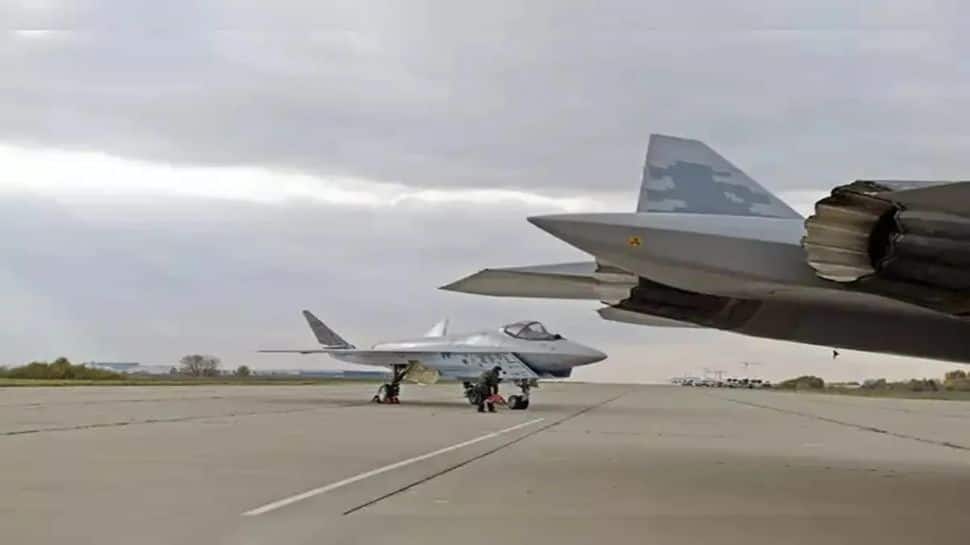
Moscow: Russia has released the first real image of its fifth-generation Su-75 Checkmate fighter jet. The photo, which went viral on social media, shows a technician attending to the aircraft with a Su-57 stealth fighter visible in the background. The photo was officially posted by the United Aircraft Corporation (UAC), the manufacturer of both the Su-57 and Su-75, on its Telegram channel.
While the UAC post did not disclose the flight readiness of the aircraft, it highlighted the Su-75’s unique V-tail design.
Experts explain that this tail replaces the traditional vertical fins and horizontal stabilisers with two angled surfaces forming a ‘V’ shape. This structure performs the dual functions of rudder and elevator, allowing the jet to remain stable in the air while making it more difficult to detect on radar.
The photograph shows the Su-75 painted in the same checkered pattern as Russia’s Su-57 stealth fighter, making it difficult to distinguish the two jets at first glance.
Until now, the Su-75 had only been seen in models or mock-ups. Experts suggest that the appearance of this real prototype signals a major step forward for Russia’s aviation industry, indicating that the ‘Checkmate’ project has now entered the prototype testing phase.
The Su-75 Checkmate was first introduced at the Dubai Airshow in 2021. It is designed as a single-engine and low-cost fifth-generation stealth fighter capable of challenging advanced aircraft such as the US F-35 Lightning II. Russia aims to offer this fighter to nations unable to purchase more expensive American or European jets. The estimated price of the Su-75 is around $25-30 million per unit, less than half the cost of an F-35.
At present, it remains unclear whether the Su-75 is ready for flight testing. Russia has not disclosed any test locations or timelines. No official information has been provided regarding the jet’s operational capabilities, weapons systems or missile capacity.
However, experts highlight that the release of this image sends a strong message: Russia is signalling its ongoing technological capability to compete with the United States in advanced military aviation.