

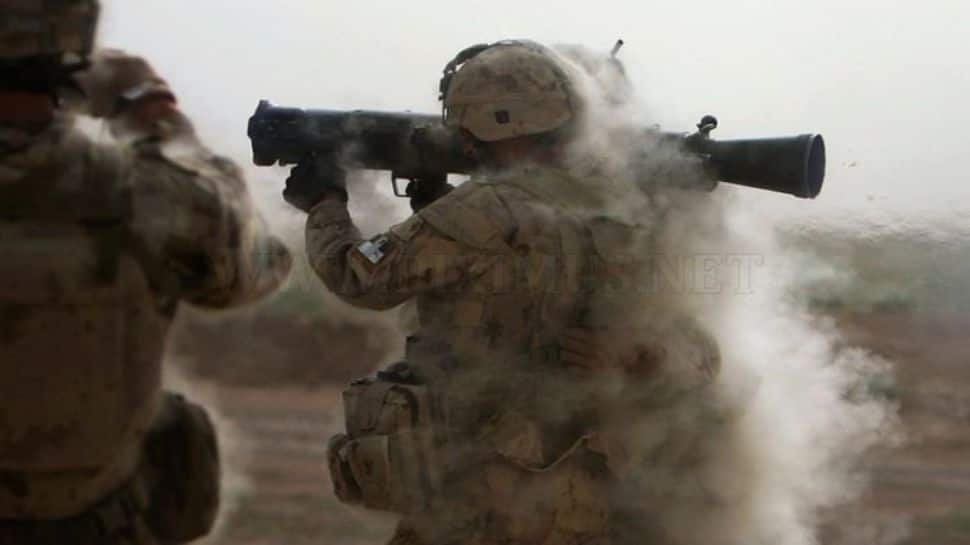
New Delhi: Military power continues to define global influence in 2025. Countries with vast armies, modern weapons and strategic reach shape the rules of engagement far beyond their borders. Defense spending, nuclear arsenals, technological advancement and the ability to operate across land, sea, air and space are central to global dominance.
Here are the 10 nations that dominate the modern battlefield.
United States
The United States remains the unmatched military giant. Its defense budget of nearly $900 billion funds over 2.1 million personnel. Eleven nuclear-powered aircraft carriers, stealth aircraft and more than 750 overseas bases grant the United States unparalleled global reach.
Advanced drones, cyber capabilities and space operations make it capable of projecting force anywhere in the world.
Russia
Russia fields 3.5 million troops and the world’s largest nuclear arsenal, backed by $126 billion in annual defense spending. Its tanks, artillery and battle experience remain unmatched.
Moscow continues to invest in hypersonic weapons and sophisticated air defenses, ensuring it retains influence across Europe and the wider region despite sanctions.
China
China has modernised rapidly, spending $267 billion on its armed forces of over 3.1 million personnel. It boasts the world’s largest navy by number of ships, stealth fighters like the J-20 and advanced missile systems.
Beijing focuses on cyber warfare, space technology and AI, challenging U.S. influence in the Indo-Pacific with unprecedented speed and scale.
India
India has more than 5.1 million armed forces personnel with a defense budget of $75 billion. Nuclear weapons and a credible delivery system complement a growing naval fleet.
Indigenous programmes such as the Tejas fighter jet and Arihant-class submarines enhance India’s capabilities, establishing it as a key strategic force in Asia.
South Korea
South Korea maintains nearly 3.8 million troops and a $46 billion defense budget. Facing threats from North Korea, it has advanced missile defense, modern fighter jets and cutting-edge armored vehicles.
Strong domestic defense production and reliance on U.S. deterrence make it a high-tech military powerhouse in Asia.
United Kingdom
The United Kingdom has 1.1 million personnel and spends $72 billion annually. Nuclear submarines, two aircraft carriers and F-35 fighters strengthen its global reach.
Intelligence networks and cyber warfare capabilities allow the United Kingdom to operate worldwide despite its smaller size relative to other major powers.
France
France fields 376,000 personnel with a $55 billion defense budget. A full nuclear triad, Rafale jets and the aircraft carrier Charles de Gaulle provide global reach.
Overseas territories, EU leadership and investments in cyber and space capabilities reinforce France’s independent power projection.
Japan
Japan maintains 328,000 troops with $57 billion in defense spending. Constitutional limits restrict offensive operations, but its naval power, missile defense, F-35 jets, advanced submarines and Aegis destroyers give it unmatched technological strength.
Rising regional tensions are driving a more assertive military stance.
Turkey
Turkey operates 8,83,000 troops with a $47 billion budget. Its domestic defense industry, particularly drones such as the Bayraktar TB2, is renowned worldwide.
Positioned at the crossroads of Europe, Asia and the Middle East, Turkey combines regional influence with NATO obligations, making it a unique military actor.
Italy
Italy’s 289,000 personnel are supported by a $31 billion defense budget. Two aircraft carriers, modern jets and a capable naval fleet allow it to contribute significantly to NATO operations.
Its well-balanced force ensures European and Mediterranean security while supporting international missions.
The rankings rely on data from the Global Firepower Index 2025 and public defense assessments. These nations demonstrate how military might, technological investment and strategic planning continue to shape global security in the modern era.